
Your cart
There are no more items in your cart
Boxwood disease: fight against Cylindrocladium Buxicola
Categories :
Chronology
, Ornamental
Boxwood is a slow-growing ornamental plant that is particularly susceptible to attacks by a specific phytopathogenic fungus (Cylindrocladium Buxicola), which causes the disease known as boxwood fire.
In the course of this article, we will analyze the specifics of the disease, and then suggest some precise strategies for fighting.
Index
Boxwood fire: characteristics of fungal disease
Boxwood disease: fungicidal control
Interventions to be done on boxwood for hobbyists without a license
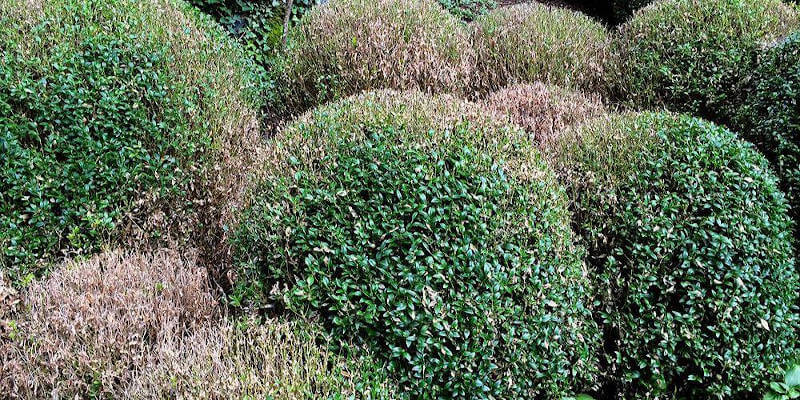
Boxwood fire: characteristics of fungal disease
Boxwood disease is favored by prolonged humidity conditions (both atmospheric and soil). For this very reason, boxwood plants are susceptible to attack by Cylindrocladium Buxicola at any time of the year. Unfortunately, there are no varieties of boxwood resistant to a possible attack by the fungus: even species such as Buxus Sempervirens, Buxus Microphylla, Buxus Sinica are possible host plants.
How does Cylindrocladium Buxicola work ?
The fungus penetrates the wood and damages the lymphatic vessels of the plant, reducing or eliminating its lymphatic circulation and thus causing the so-called forest fire. This disease manifests itself through a circular yellowing of the leaves, which can cause a general drying of the plant (up to total bareness), thus compromising the aesthetics of the plant and its commercial value.
Boxwood fire finds its ideal habitat in nurseries, especially in greenhouses. The fight must be quite tight given the length of the ideal period for its diffusion and the products to be used are different, both conventional and biological.
*
Boxwood disease: fungicidal control
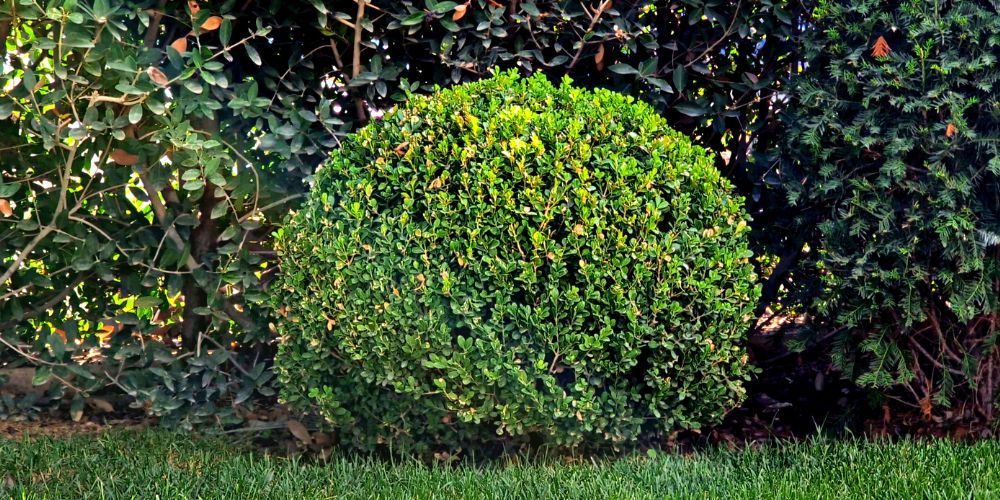
In this paragraph, we will analyze fungicide control strategies, starting from some specific situations:
1. If you are talking about nurseries, it is very likely that you are in possession of a license for professional products. In this case, to quickly and completely eradicate boxwood disease, we recommend the use of a mixture of products, which will help the active ingredient to enter the lymphatic vessels of the plant, completely eliminating the phytosanitary problem:
- Inex-A (dosage: 30ml/100lt)
- Switch (dosage: 50ml/100lt)
- Kendal Tea (dosage: 200ml/100lt)
2. If you are inside a greenhouse and, for various reasons, it is not possible to treat with chemicals, our agronomists have tested, with excellent results, some zero-residue solutions.
It is a very special intervention that, through the use of hydrogen peroxide mixed with zinc ions, manages to inactivate and destroy the fungus, when it comes into contact with it. Precisely for this reason, our advice is to water the plant to be cared for very well. In this case, the products to be used are:
This strategy will also prove effective against other diseases.
Would you like to receive our advice? Subscribe to our Newsletter - 8% discount now for you
|
|
Interventions to be done on boxwood for hobbyists without a license
Spray treatment on the leaves with a nebulizer to mix the following products :
1. Kyprion = 30ml / 10 lt water
2. Propolis = 30 ml / 10 lt water
or
1. Vitikappa PFnPE = 50 gr / 10 lt
Surely the first intervention, since it consists of the mixture of two products, will be more durable and effective for the health and general vitality of the plant.
The Kyprion product also has a particular action if administered by irrigation, in addition to the spray intervention. In fact, we recommend it above all as a prevention on all crops at a dose of 50 ml in 10 liters.
Finally, we recommend proceeding, whatever the treatment to be used, with careful wetting, to allow the plant to absorb the greatest possible amount of the chosen product.
... TECHNICAL ADVICE..
1. All the products mentioned can also be used by root, with a reclamation action on the soil where Cylindrocladium Buxicola can spread even for some time.
2. Before carrying out any treatment, it is important to remove fallen leaves from the plant, because they could act as a vector for boxwood fire.
3. During the treatment, make sure to wet the surrounding soil well as well.
Share this content








 Chronology
 Citrus fruits
 Turf
 Stone fruit
 Olive tree
 Ornamental
 Vegetables
 Actinidia (Kiwi)
 Screw
 Hobbies and insights
 Pome Fruit


