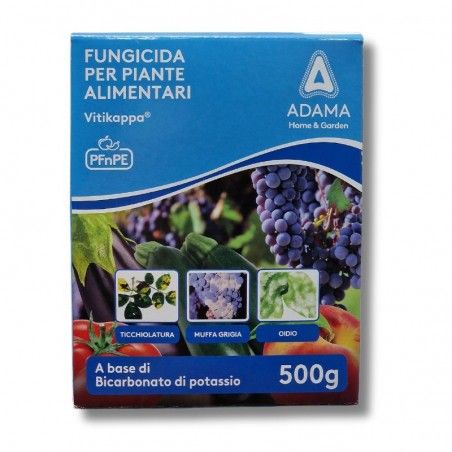
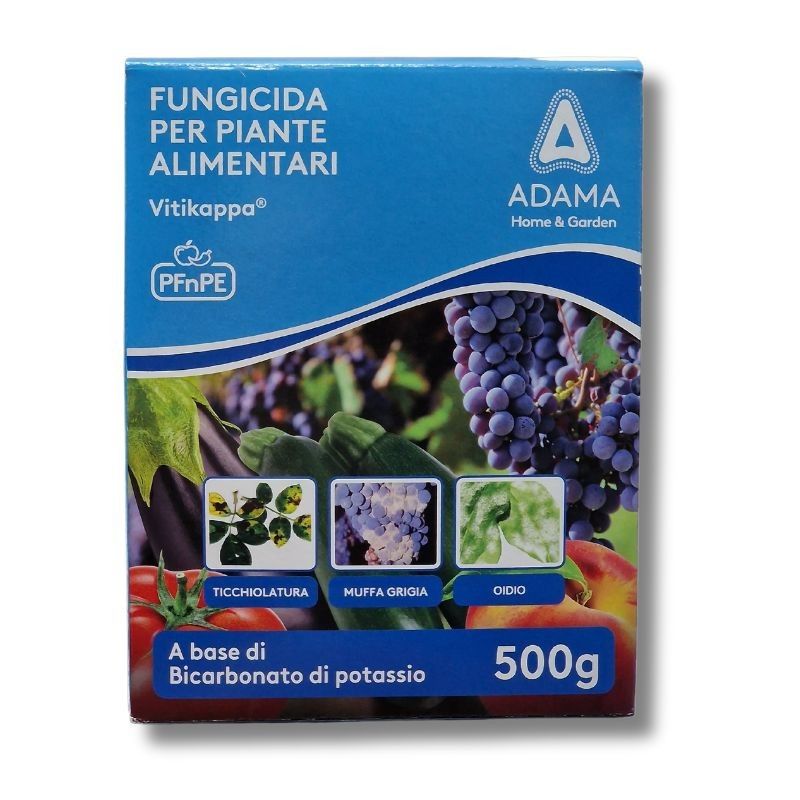
Vitikappa PFnPE prevents rot - for food plants, based on potassium bicarbonate - 500 g
Vitikappa is a contact fungicide with preventive and curative effects against certain fungal diseases such as scab and powdery mildew. Vitikappa has a complex working principle that acts through a combination of different effects: pH, osmotic pressure and the specific effects of the bicarbonate ion. The combined action of these factors causes the bursting and desiccation of hyphae until the total collapse of the mycelium of susceptible fungi. Vitikappa also asgresses the viability of fungal spores. Allowed in Organic Farming.
Composition
- Potassium bicarbonate 98.9%
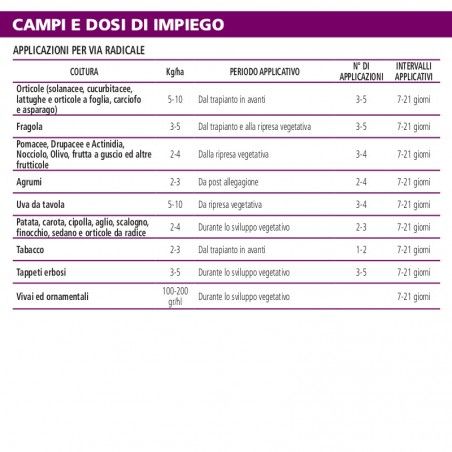
Doses, times and fields of use:
- Pome fruit: Scab, max 0.75 g/m2 in max 150 ml water/m2. maximum of 6 treatments per year from the "mouse auricle" stage until advanced maturity. Powdery mildew, max 0.5 g/m2 in max 100 ml/m2. Maximum of 6 treatments per year from the "mouse auricle" stage until advanced ripening.
- Table and wine grapes: Powdery mild ew, max 0.6 g/m2 in max 100 ml water/m2. maximum 6 treatments per year starting from the second leaf distended stage, to fully ripe fruit stage. Minimum interval between applications: 3 days. Gray mold, max 0.6 g/m2 in max 60 ml water/m2. Maximum of 4 treatments per year starting from the 80% dropped calyptra stage to the fully ripe fruit stage. Interval between applications: 3 to 7 days.
- Cucurbits: Powdery mildew, max 0.5g/m2 in 100 ml water/m2. Maximum of 6 treatments per year from fully distended cotyledons to fully ripe fruit stage. Minimum interval between applications 3 days.
- Stone fruit: Powdery mildew, max 0.5 g/m2 in max 100 ml of water/m2. Maximum of 6 treatments per year from bud break stage to advanced fruit coloration stage. Minimum interval between applications : 6 days. Gray mold, max 0.5 g/m2 in max 200 ml/water/m2. Maximum of 4 treatments per year from petal fall stage to mature fruit stage. Moniliosis, flower wilting max 0.75 g/m2 in max 150 ml/water/m2. Maximum 5 treatments per year starting from the beginning of flowering until the end of flowering(fall of all petals). Minimum interval between applications: 3 days. Blackness of stone fruit, max 0.5 g/m2 of product per meter of crown height . Maximum of 3 treatments per year from the advanced fruit coloring stage to the ripe fruit stage.
- Solanaceae(tomato, eggplant bell pepper, chili pepper, alchechengio and pepino): Powdery mildew, max 0.5 g/m2 in max 120 ml of water/m2. Maximum 6 treatments per year starting from the second leaf stage of the main spreading shoot to the fully ripe fruit stage. Interval between applications 3 - 7 days.
- Chicory, endive, lamb's lettuce and lettuce: Powdery mildew, max 0.3 g/m2 (0.25 g/m2 for lettuce) in max 60 ml water/m2. Maximum of 2 treatments per year starting from the distended cotyledon stage, up to the fully developed stage. Interval between applications 3 - 7 days.
- Parsley: Powdery mildew, max 0.3 g/m2 in max 60 ml water/m2. Maximum of 2 applications per year from the distended cotyledon stage to the full development stage. Interval between applications 3 - 7 days.
- Fresh herbs: Powdery mildew, 0.35 g/m2 in max 70 ml water/m2. Maximum of 3 applications throughout the year from the distended cotyledon stage, up to the full development stage. Interval between applications 3 - 7 days. Gray mold, max 0.5g/m2 in max 200 ml water/m2 Maximum of 4 applications throughout the year starting from the distended cotyledon stage, up to the full development stage. Interval between applications 3 - 7 days
- Umbelliferae( carrot, fennel, celeriac, celery turnip, parsnip, coriander and cumin) and scorzonera:Powdery mildew, max 0.35 g/m2 in max 70 ml of water/m2. Maximum of 3 applications throughout the year starting from the distended cotyledon stage, to the full development stage. Interval between applications 3 - 7 days.
- Leguminous: Powdery mildew, max 0.5g/m2 in max 100 ml water/m2. Maximum of 3 treatments per year starting at the fully distended cotyledon stage until 50% of pods are fully mature. Minimum interval between applications 3 days.
- Strawberry, red and white currant, black currant, blackberry, raspberry and blueberry: Powdery mildew, max 0.5 g/m2 in max 200 ml water/m2. Maximum 6 treatments per year from vegetative regrowth until the appearance of the first ripe fruit. Interval between applications 3 - 7 days. Gray mold, max 0.5 g/m2 in max 200 ml water/m2. Maximum of 4 treatments per year from petal drop stage until fruit harvest. Interval between applications 3 - 7 days.
- Gooseberry and Rubus x loganobaccus: Gray mold, max 0.5 g/m2 in max 200 ml water/m2. Maximum of 4 treatments per year from the petal drop stage until fruit harvest. Interval between applications 3 - 7 days.
- Fig: Gray mold, max 0.5 g/m2 in max 200 ml water/m2. Maximum of 4 treatments per year from the late flowering stage until fruit harvest. Interval between applications 3 - 7 days.
- Blueberry: Moniliosis, max 0.75 g/m2 in max 100 ml water/m2. Maximum of 5 treatments per year from the stage of first open flowers to the late flowering stage. Intervals between applications 3 days.
- Brassicaceae: Alternaria, max 0.75 g/m2 in max 100 ml water/m2. Maximum of 2 treatments per year starting at the distended cotyledon stage, up to the full flowering stage. Interval between applications 3 days.

 Allowed in