
Your cart
There are no more items in your cart
Lawn Fertilization - Fertilizing the Turf
Categories :
Chronology
, Turf
Index
Introduction
What is the secret to having a beautiful lawn?
Microtherms (Fescue, Poa, Ryegrass, etc.)
Macrotherms
Fungal diseases
Cutting height management
Are there any products that can limit the growth of the lawn?
The turf - when and how to fertilize
Introduction
Fertilizing turf is a very important practice if you always want to have a lawn with a bright, lush color and above all that resists adversity.
The right fertilization of the lawn, however, is determined by various conditions which are the climate, exposure and variety of the turf.
The most important nutrients are macro-elements such as nitrogen (N), phosphorus (P) and potassium (K) and micro-elements such as iron (Fe), magnesium (Mg) and calcium (Ca).
Nutritional needs vary according to climatic conditions and seasons.
The best results will be obtained when the necessary elements have already been distributed to the ground and therefore ready and available for the lawn.
Potassium is the element that helps prevent thermal stress and, to ensure that it performs its function at its best, it is important to administer it at least 30 days before the presumed stress condition. In this way, the fertilizer will begin to activate in the soil and will be available when it is actually needed.
Would you like to receive our advice? Subscribe to our Newsletter - 8% discount now for you
|
What is the secret to having a beautiful lawn?
First of all, to become passionate about the subject of turf.
Within a garden, the turf certainly plays an important role because the eye falls on the larger surface: the turf that covers the ground is therefore one of the fundamental keys in the quality and aesthetics of a garden.
It is clear that a "good cure" passes through many pieces that form a puzzle, that is, a quality turf.
Below we will address some cornerstones which are:
1) seed variety;
2) irrigation;
3) management of the cutting height;
4) nutrition.
It is important to premise that we must think of integrated management, therefore a management that does not include, for example, nutrition in an uncoordinated way from the rest, but considers every single step important and tends to coordinate it with the others in order to obtain the best final result.
Providing indications in absolute terms today is impossible and in any case it would not be correct, but what we can do, first of all, is to identify the type of use we will make of turf.
So, if we are faced with a carpet that is little exploited, such as an ornamental turf, then we will approach it in one way; On the other hand, if we have to intervene on a facility for sports use, therefore very exploited, the management will be much more difficult and demanding, therefore it will require a greater number of interventions.
Another thing to do, when we are in front of a turf, is to understand its variety, so as to distinguish between MICROTHERMS and MACROTHERMS: in fact, the fertilization plans vary depending on the species.
Microtherms (Fescue, Poa, Ryegrass, etc.)
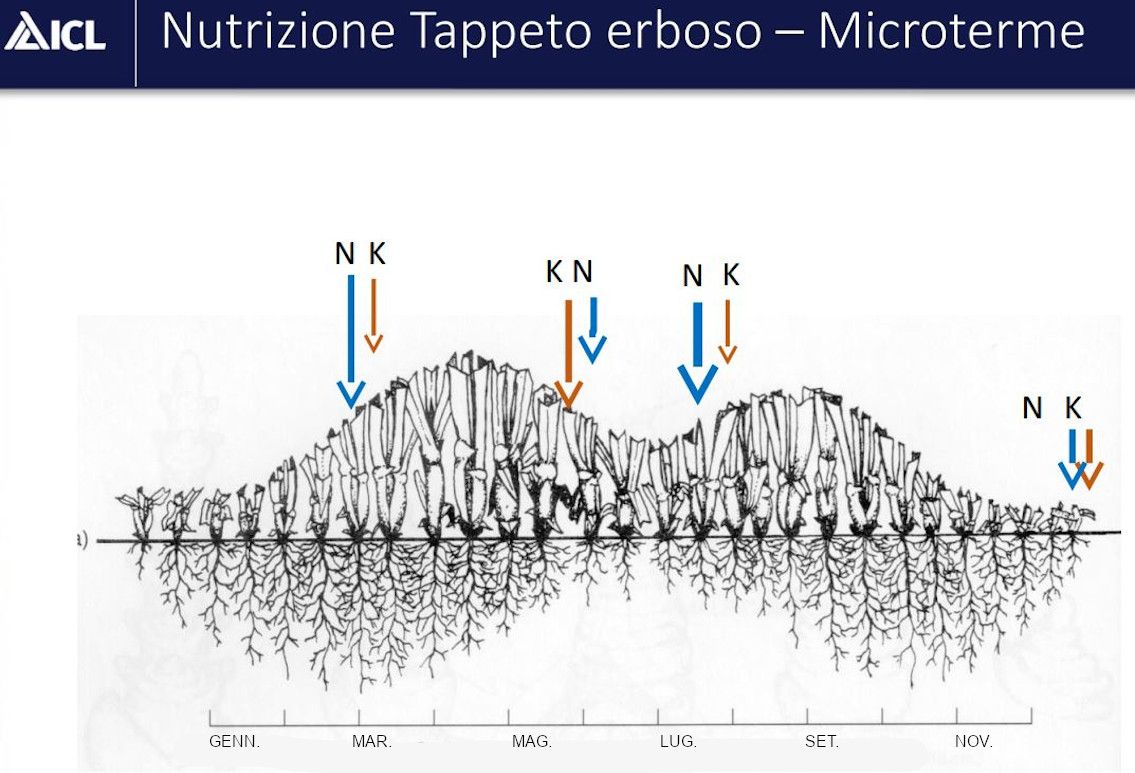
We will prefer microthermal varieties from Rome upwards, therefore in certain climatic conditions:
We know that there are two growth peaks during the year: a first, more important growth peak, in which the plant grows more actively, is in the spring period (MAR-MAY).
Subsequently, with the increase in temperatures (JUN-AUG), there is a decline in growth.
The second peak of growth is in late summer - early autumn (AUG-OCT). After that there is another downturn.
In each of the 4 periods described we will make specific fertilizations, with the fertilizers indicated above.
The choice of fertilizer will always be directed towards a specific product, designed specifically for YOU, and necessarily with controlled release.
At the Vegetative Restart (early spring) it will be necessary to apply the first granular fertilizer with a higher nitrogen content:
Just before the summer, it will be advisable to intervene with so-called anti-stress reaction products.
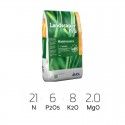
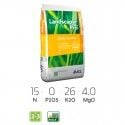
This particular type of product is defined as such as having a substantial amount of potassium inside, which has a beneficial function, as it increases resistance to abiotic stress in general.
At the end of August - beginning of September, and therefore at the end of summer, when the plant starts to grow again actively, it will be necessary to use products with a higher nitrogen content or balanced between nitrogen and potassium, and then finish, in the pre-winter phase, with the use of products with a high potassium content to strengthen the plant and prepare it for the thermal stress of low winter temperatures.
Another type of product that can be used on macrotherms in winter, especially when there are problems of color loss, consists of products with a high iron content, which help to green the plant and also, if necessary, to make the environment inhospitable to avoid the onset of moss.
Macrotherms
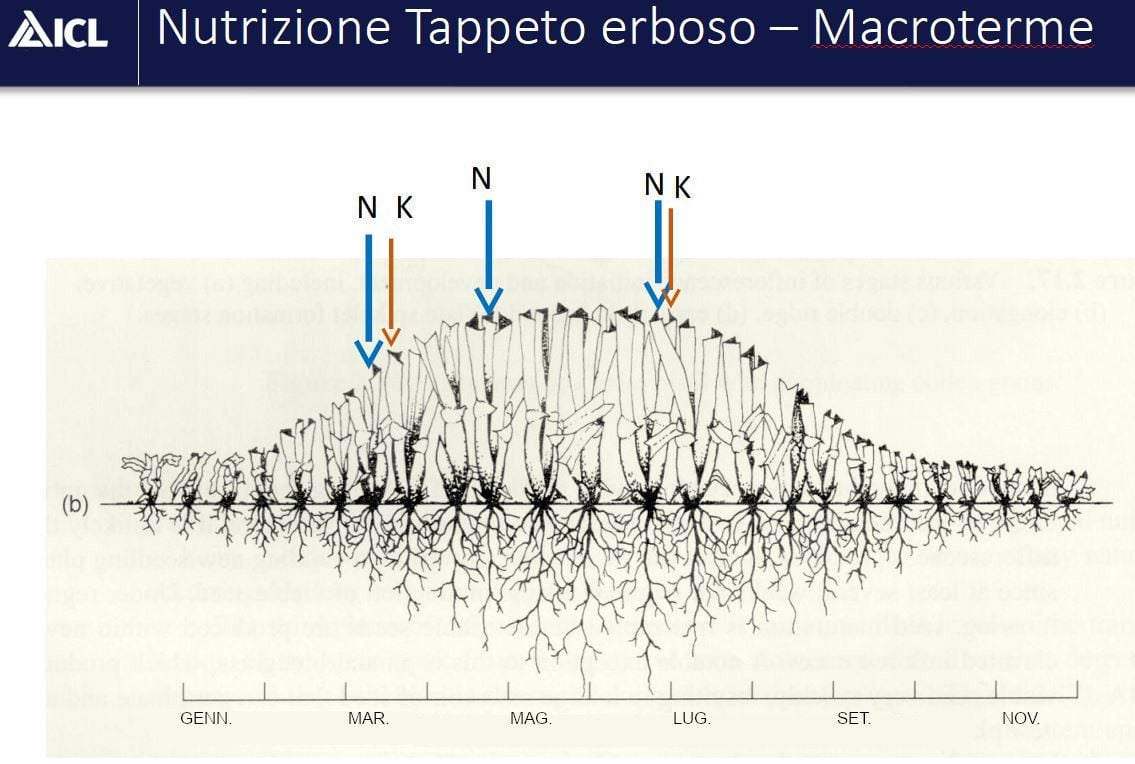
In macrothermal species, there is a more or less extensive winter dormancy depending on the species used and the real climatic zone.
It is clear that vegetative dormancy, and therefore the complete loss of color that macrothermal species have, varies depending on the geographical area: when temperatures go below 10 degrees, the macrotherm species goes completely dormant, so the color of the carpet is yellow or brown, depending on the species, and starts again when temperatures return to exceed 20-25 degrees.
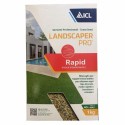
As we learn from the sheet kindly offered by ICL TURF, the macrothermal species has an important growth rate already from the vegetative restart, which we assume takes place, depending on the geographical area, from February to April. Then it will be important to support the turf with a higher fertilization in nitrogen and gradual release (e.g. maintenance).
Subsequently, to protect the carpet from summer stress, it will also be necessary to increase potassium, so starting from the end of April-May, the product will be used in mixtures, e.g. with Stress Control.
Fungal diseases
Among the most common fungal diseases we find:
-
Rhizoctonia
-
Pythium
-
Fusarium
-
Anthracnosis
-
Sclerotinia or Dollar Spot, etc.
It is important to make a premise: chemical defense for the treatment of fungal diseases is to be considered only the last resort, in the sense that we always try to limit the use of chemicals by working better in prevention.
Working in prevention, as mentioned, means in particular carrying out an integrated approach by managing irrigation, cutting and nutrition well so that the plant is less susceptible to attack by pathogens.
The phase in which the plant is most prone to the proliferation of fungal diseases is during the rise in temperature.
Our choice is always directed towards organic products composed of micro-organisms:
-
PROTECTS BOTTOS (free sale)
-
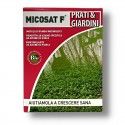
Micosat Lawns & Gardens (free sale)
-
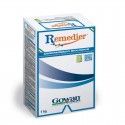
Remedier (Skate)
If we analyze these products, we find "antagonist" fungi within them, i.e. fungi that, once in the soil, colonize it, taking away space for other fungi present there that live in a saprophytic way, i.e. feeding on dead organic matter, and destined to become pathogenic for our turf when the conditions occur.
This colonization significantly reduces the load of the pathogenic fungus in the summer.
They must therefore be used at the spring resumption and at least two treatments must be carried out so that the antagonistic fungi contained in the product have a way to colonize the soil, taking away space from the other saprophytic fungi.
The key thing for a correct application of the product is that the product reaches the ground. For example, in the case of meadows on which we have not practiced felting, i.e. aeration, for some years, in addition to the well-known problems due to the reduced gas and water exchange of the same with the outside, this will also hinder the deep penetration of the product.
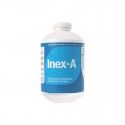
To be sure of a good result, the felt must therefore be removed and penetrating wetting agents (such as INEX-A ) must be used so that the product can reach the ground. Often, in fact, the products do not work because the application has not been carried out correctly and in particular the right amount of water has not been used.
Cutting height management
Usually the owner of the garden loves an "English" cut but this should not be recommended because, the lower the turf is cut, the more the plant is under stress and the frequency of cutting must be increased.
There is a simple rule to follow: the 1/3 rule, meaning that a maximum of 1/3 of the total height should be exported. So, if you have a cutting height of 6 cm, I will cut every time you reach 9 cm. If, on the other hand, the height is 4 cm, I will cut when it reaches 6 cm.
That said, since a plant takes almost half the time it would take to grow 3 cm to grow 2 cm, the number of cutting operations should be increased accordingly. It is therefore advisable to keep the ornamental turf at 5/6 cm, thus subjecting it to less stress when cutting it to 8/9 cm.
It should also be considered that the taller the plant, the more extensive the leaf surface; the healthier the plant is and the more the root system is developed, the fewer problems of water stress it will have.
So it is certainly recommended to have, in the summer and winter, a taller plant, to give it a benefit. Advice that should be applied all year round, to have a lawn that is both beautiful and healthy.
Are there any products that can limit the growth of the lawn?
The first action we can take to have a gradual growth, and therefore a lower biomass removal, is the use of a controlled release fertilizer which, thanks - precisely - to the controlled release of the nutrient, ensures that the plant does not have growth peaks and reduces the biomass produced in a year by 20%.
Once fertilized correctly, you can also resort to the use of a specific and registered product: the Primo Max 2.
Widely used all over the world, it is a product that must be used liquid and that does not block the plant but ensures that it has a lower growth rate, intervening on the synthesis of a hormone and reducing cell distension.
The product also has other benefits because it actually allows the plant, which continues to do photosynthesis, to have greater root growth, greater density, greater coloration and greater tolerance to certain stresses.
The product is applied in periods of poor growth and can be given on all species in different doses, with an effect that lasts about 4/6 weeks.
Primo Max should be used as a growth reducer in microthermal species during the spring peak, when 3 treatments are recommended, and in the autumn peak, during which a single treatment is recommended.
Watch our interviews (three parts):
Share this content


 Chronology
 Citrus fruits
 Turf
 Stone fruit
 Olive tree
 Ornamental
 Vegetables
 Actinidia (Kiwi)
 Screw
 Hobbies and insights
 Pome Fruit


By Maurizio 2019-11-05 15:29:35
Salve,leggo nella guida la concimazioni da effettuare a ottobre con concime ad alto titolo di azoto,ma non si dovrebbe dare uno con alto titolo di potassio tipo landscaper pro stress prima dell'inverno? RISPOSTA : La dotazione di sali nella vegetazione, (azoto concorre ad arricchire di sali la vegetazione), aumenta la resistenza agli stress abiotici (caldo, freddo, siccità), perché la concimazione azotata autunnale non produrrà vegetazione, ma riserve pronte alla ripresa vegetativa primaverile.
By daniele 2019-02-14 14:28:09
Salve, la guida dice che circa a metà febbraio andrebbe usato Tionamm. Che dosaggio bisogna usare? Ed in che modo lo si usa? grazie --- RISPOSTA: Il prodotto si impiega a spaglio sul tappeto erboso alla dose di 5-6 kg x 100mq , è consigliabile una leggera irrigazione dopo l’applicazione.