
Your cart
There are no more items in your cart
Defending crops with Entomopathogenic Nematodes
By :
LA FROSCIA -
Categories :
, Chronology
Index
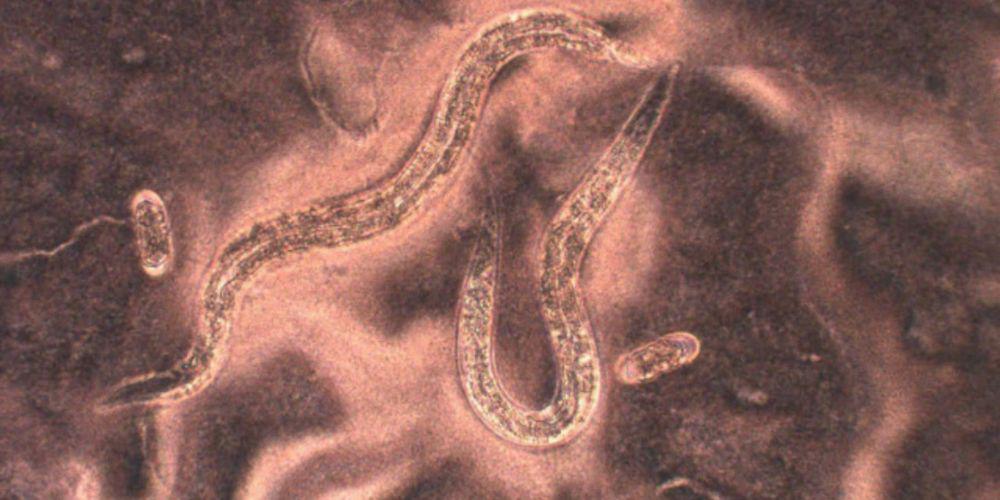
The sustainable defense of crops from adversity today finds many possible paths, one of these, very innovative and effective, passes through the use of entomopathogenic nematodes.
Nematodes are cylindrical organisms so small that they are invisible to the naked eye. It is a boundless world, made up of about 20,000 species that feed on everything. They are herbivorous, bacteriore, fungivorous and carnivorous species .
We refer to carnivorous species that attack and parasitize only certain targets, and in particular larvae of wireworms:
- Beetle
- Popilia,
- Capnodium,
- Oziorrhynchus,
- Red weevil,
- Paysandisia,
- and others.
Entomopathogenic nematodes do not attack the roots of cultivated or spontaneous plants. They represent an important resource both in organic farming and in integrated and conventional agriculture, and are able to solve problems that chemistry does not solve or at least not in a sustainable way. The genera Steinernema and Heterorhabtitis are part of the beneficial entomopathogenic nematodes, organisms with an obligate parasitic behavior: they are able to survive only at the expense of other organisms, in particular harmful insect larvae of various orders (beetles, lepidoptera, diptera, buprestids).
Would you like to receive our advice? Subscribe to our Newsletter - 8% discount now for you
|
What do entomopathogenic nematodes actually do?
Mechanism of action
Entomopathogenic nematodes have a only larvicidal action, in fact, the intermediate stages of development (pupae and chrysalises) and adults are rarely parasitized. In the larval stage, entomopathogenic nematodes penetrate the host insect through body cavities (oral cavity, cuticle, tracheal spiracles, anus) releasing symbiotic bacteria which, feeding on the host's tissue, cause its death within a short time: between 24 and 72 hours.
How to use
Entomopathogenic nematodes, to be effective, require an adequate humidity rate and soil temperatures not below 8°-10° degrees. Since these are organisms that are very sensitive to ultraviolet rays, it is advisable to carry out the applications during the hours of the day when the insolation is reduced, and intervene immediately afterwards with irrigation to keep the humidity high and convey the nematodes below the surface, and allow them to move easily in the film of water between soil particles, to reach the target. On dry plants or soil, entomopathogenic nematodes cannot survive.
Areas of application
Entomopathogenic nematode products are widely used in agriculture, from fruit trees to ornamental tree plants, from nurseries to vegetable and strawberry crops.
Suggested products
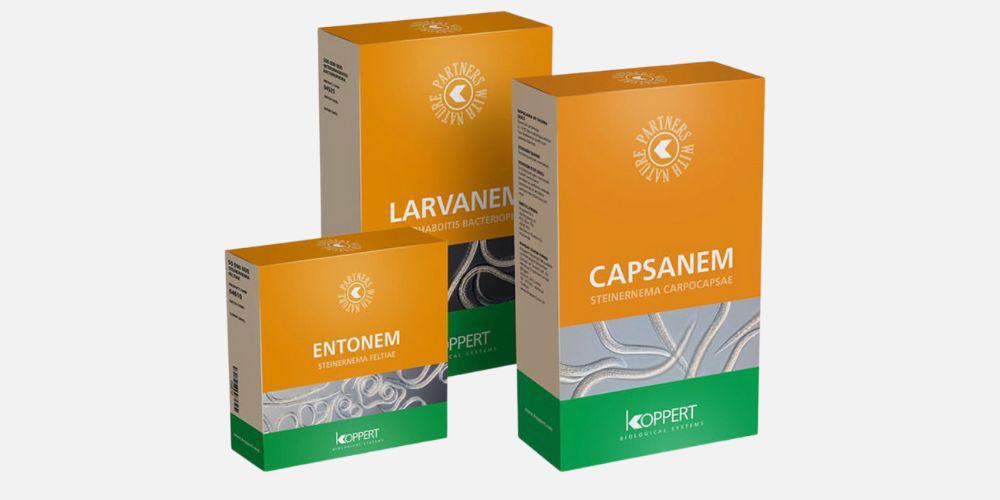
- Larvanem: product based on Heterorhabditis bacteriophora, very useful for the control of : red palm weevils, larvae of Japanese beetle (Popilia Japonica) and larvae of oziorrhynchus, larvae of beetle that destroy lawns, larvae of Ferretti, wireworms great enemies of the cultivation of potatoes, carrots, melons, watermelons and many others. It should be distributed by fertigation, or with a watering can, or with a pressure pump.
- Entonem: product based on Steinernema feltiae, useful for the biological control of larvae of sciarids commonly called mushroom gnats ; it is used by spraying the product on the substrate, as well as thrips larvae, and larvae of oizrhynchus that are fought by introducing the solution into the soil by fertigation or injector pole.
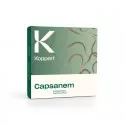
- Capsanem: product based on Steinernema carpocapsae, suitable for the control of capknode (Capnodis tenebrionis), beetle larvae and mole cricket larvae. It is used by introducing the solution into the soil by means of fertigation or an injector pole.
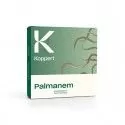
- Palmanem: product based on Steinernema carpocapsae indicated for the protection of palm trees from the well-known red weevil and the palm butterfly (paysandisia archon). Palmanem's solution should be introduced into the palm cone when there is, or is suspected, the presence of larvae.
The use of nematodes is an alternative practice to chemical control by endotherapy, a practice that is not respectful of the environment and the ecosystem.
We believe that the only means for the defense of palm trees from weevil, meadows from beetle and popillia, nightshades and cocurbits from underwires, are precisely nematodes, an effective and totally eco-sustainable means .
The products described above are completely harmless to higher animals and in general to all other non-target organisms, they do not release pollutants into the environment and no toxic residues in the crops.
Share this content




 Chronology
 Citrus fruits
 Turf
 Stone fruit
 Olive tree
 Ornamental
 Vegetables
 Actinidia (Kiwi)
 Screw
 Hobbies and insights
 Pome Fruit


