
Your cart
There are no more items in your cart
Turf Treatments Calendar
Categories :
Chronology
, Turf
Index
December-January: Lower temperatures
February: vegetative awakening
Lawn-easy : guide to lawn care and maintenance
Do you have a turf and don't know how to handle it? Or do you already have knowledge about it but want to deepen it thanks to the advice of our technicians? One of the most recurring questions we are asked on our website is the following: when to do lawn treatments ? For this reason, we have decided to make it easier for our customers by publishing this guide.
Here is a simple and effective annual lawn program , which will help you keep your turf healthy and lush.
The turf treatment calendar we propose is as follows:
1. December-January: Lower temperatures
With temperatures close to freezing, the vital processes of the turf, especially macro-thermals, slow down, leading to yellowing of the leaves, loss of color and dehydration.
A treatment we recommend to reduce this strong stress is to use an anti-stress fertilizer such as
- Megafol: is a selected algal complex processed with advanced processes, which stimulates seedlings to activate their defenses against abiotic stress. The recommended dose is 50 cc in 10 liters of water, enough in 100 square meters. It will help the plant to overcome the rigors of winter without losing color. To be applied 2 or 3 times.
2. February: vegetative awakening
Nature is now close to waking up, spring is just around the corner, so it's time to prepare the lawn to be able to enjoy it in all its splendor.
After a thorough cleaning of old leaves and weeds and after a slightly shorter mowing, appropriate nitrogen fertilization must be carried out, useful for a robust start of the new vegetation. We at perfarelalbero,it recommend:
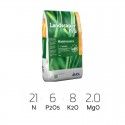
- Maintenance 20-5-8+2mg at a dose of 3-5 kg per 100 sqm. It is a granular fertilizer, therefore without the annoying dust, easy to spread, with controlled release nitrogen, which will ensure balanced nutrition for at least two months.
3. March: rising temperatures
In this month the temperatures begin to rise, the days become longer so there are all the conditions for the development of telluric and leaf fungi as well as for the awakening of parasites that could lead to the destruction of the roots causing the premature death of the seedlings.
Our proposal for a definitive reclamation of all the enemies of the lawn is:
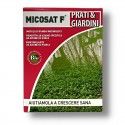
- Micosat lawns & gardens at a dose of 1 kg/1000 sqm; it is a complex of fungi and bacteria of the rhizosphere in a granular formulation that is easy to spread, which acts in a preventive form against all harmful fungi, root and foliar.
- Larvanem, or live nematodes that fight beetle larvae.
These treatments create conditions of balance in the soil microbiota and in the leaf microenvironment, a balance that allows the plant a healthy and balanced life without other chemical defense interventions. Lawns treated in this way are immediately usable by children and pets because there are no harmful chemical residues.
4. April
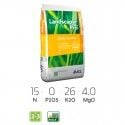
In this month, if the interventions with micosat and larvanem mentioned above have been carried out, there will be no need for new interventions, at most a maintenance fertilization with Landscaper Pro Universal Balanced
Would you like to receive our advice? Subscribe to our Newsletter - 8% discount now for you
|
|
5. May
In this month a second preventive intervention is appropriate with:
- Micosat lawns & gardens, always at a dose of 1 kg/1000 sqm.
It is advisable to carry out the distribution if possible late in the afternoon and to follow a short watering . It is a safety intervention to further enrich the biota with useful fungi and bacteria.
With summer just around the corner, it is necessary to open a parenthesis on the correct irrigation of the turf:
It is a common belief that lawn irrigation should be carried out in short shifts (a few minutes) and repeated several times over a 24-hour period.
If we consider the type of root system of grasses: "fasciculated" i.e. made up of many roots with equal dominance that can develop up to a depth of over 50 cm, roots that explore the soil in search of water and nutrients, how can you think of sending water deep if you carry out irrigation in shifts of a few minutes?
Our experience suggests carrying out periodic irrigation, once or twice a week and possibly in the evening, with a volume of water of at least 5 cubic meters per 1000 square meters, which is equivalent to 5 liters per square meter.
By doing so, a veil of water of half a centimeter will be distributed which will be able to satisfy a layer of earth of 4-5 cm (conditioned by the structure of the soil), obviously larger volumes (preferable) increase the depth of wetting, thus increasing the "reservoir - reserve" of water available to the roots, which will be able to supply water to the aerial apparatus for longer, without interruption and without putting the plant under stress.
It will be enough with a common wooden stick to check that the wetting, after irrigation, is at least 5 cm and in a simple way decide to irrigate again when you notice a slight change in color, from bright green to a darker green. Obviously, you can equip yourself with probes that will help decide quantities and shifts.
We therefore exclude short and repeated irrigation several times in 24 hours, which in addition to not creating reserve and constancy of water availability, forces the root system to develop in a limited and only superficial way, unable to support the plant in the moments of greatest need for water, exposing it to continuous stress that makes it more vulnerable to the aggression of harmful fungi and bacteria.
The continuous wetting creates excess surface humidity, creating an environment favorable to the development of fungi and rust, to the detriment of the health and beauty of the turf.
6. June: temperatures rise
It's time to prepare the lawn for the summer for which fertilization with a high potassium content complex is necessary:
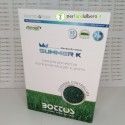
Stress control or Summer k 10-0-30
The recommended dose is 30-40 g, low dose in nitrogen, to avoid excess vegetation danger of powdery mildew and rust development. Magnesium, an important element for chlorophyll photosynthesis, will ensure a bright green
In the months to come, the lawn will only need mowing, irrigation and to enjoy its beauty in complete tranquility having not administered any residual product until now.
7. July-August
Two hot months that will put a strain on the turf, in any case already prepared for this test, it is not necessary to do anything else, but help can always come in handy by carrying out maintenance fertilization with:
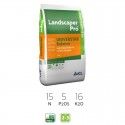
- Universtar balanced 15-5-16, at a dose of 2030 gr/sqm, will be used to supplement what has been removed with mowing.
If you want to increase the root system, you can intervene with:
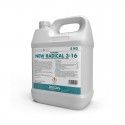
- New radical 3-16 at a dose of 250-500 gr per 100 square meters, dissolved in 10-20 liters of water.
To enhance color and brilliance, carry out foliar fertilization with:
- Help 10-5-7+Micro at a dose of 250-500cc per 100 square meters, dissolved in 10-20 liters of water.
8. September
In this month, with the improved climatic conditions, the lawn is not subject to particular stress, but it is necessary to prepare it to face the winter, and recover all the energy lost in the hot summer period to defend itself from extreme conditions.
To rebuild the consumed reserves that will then be needed in the coldest and least sunny period that we are going to face, nothing better than a good balanced fertilization prevalent in nitrogen which is the element (fundamental for all the processes of chlorophyll photosynthesis) that most of all needs to accumulate in the roots to be ready and available when needed:
- Maintenance 20 - 5 - 8 + 2 MgO, at a dose of 2 - 3 kg per 100 square meters, twice 15 - 30 days apart.
It will be necessary to thin out irrigation as water needs are reduced due to lower temperatures and less transpiration. It will be sufficient to lengthen the shifts without decreasing the volumes for each irrigation.
The lawn stressed and weakened by the summer period is very sensitive to fungal attacks, such as rust, yellow spots, pythium, and in any case all root diseases, useful to prevent with Micosat Lawns & Gardens, at a dose of 1 kg per 500 - 1000 square meters (higher doses are only good).
Even beetle and popillia in this period lay eggs which will then become destructive larvae for the turf, so let's prevent and treat with:
- Klozer G20 at a dose of 1 kg per 250 square meters is sufficient to reclaim the soil from beetle, popillia, ferretti, mole cricket larvae.
Very important: the recommended products are all zero residues, respectful of the environment, man and 4-legged friends.
9. October-November
In this period, it is only necessary to maintain the turf and schedule pre-winter fertilization.
If you have chosen to split the fertilization, you can recall the September fertilization with:
Maintenance 20-5-8+MgO at 2Kg/100sqm, in the first half of October
At the end of November, beginning of December, we will use Summer K 10-0-30.
Share this content






 Chronology
 Citrus fruits
 Turf
 Stone fruit
 Olive tree
 Ornamental
 Vegetables
 Actinidia (Kiwi)
 Screw
 Hobbies and insights
 Pome Fruit


