
Your cart
There are no more items in your cart
Chestnut cultivation
Categories :
Chronology
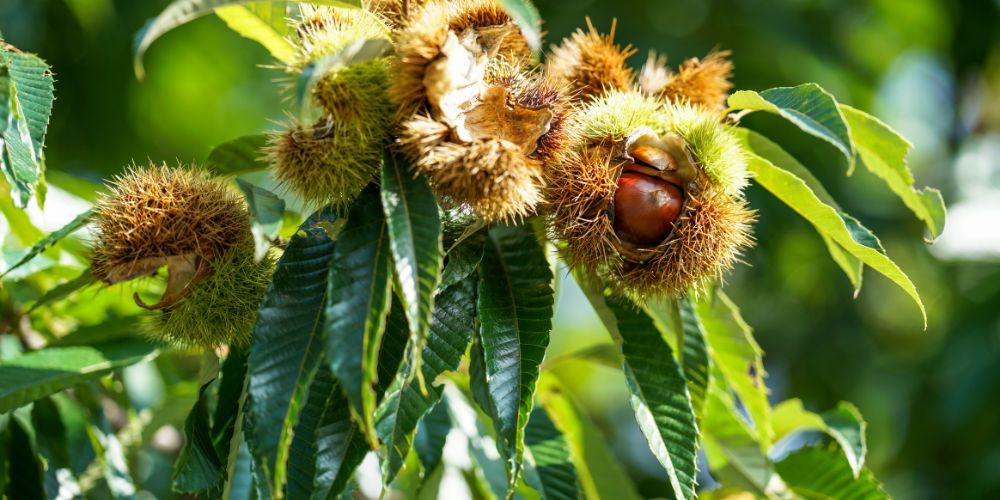
The chestnut tree is an arboreal, monoecious plant - dicline (similar in this characteristic to the hazelnut), which can reach over 25 meters in height.
Although at first glance it may seem a very rustic plant, the chestnut tree prefers fertile, deep soils rich in organic matter. On the contrary, it fears acidic soils, water stagnation and intense frosts.
As far as plants intended for fruit production are concerned, it is essential to intervene with targeted practices at the most appropriate times.
Index
Nutritional management of chestnut trees
Brown rot (Gnomoniopsis Castaneae)
Phytophthora Chinamoms and Phytophthora Cambivora - Inksickness
Cydia Splendana and Cydia Fagiglandana - Lepiduschestnut trees
***
***
Nutritional management of chestnut trees
Basically, given the good amount of leaf mass that falls on the ground at the end of each production cycle, the amount of organic matter present in the soil is never lacking.
However, during the cultivation cycle, due to removals, tillage, and the high temperatures that now characterize almost all seasons, it is good practice to distribute in the post-harvest phase:
- Agri Bio Aktiv (dosage: 10-15 quintals per hectare)
Thanks to its strong water retention capacity, the organic substance will help the chestnut tree in periods of greater drought. This help will be essential especially if the crop does not have an irrigation system. In addition, the s.o. will retain the nutritional elements in the best possible way.
At the end of February-beginning of March, our advice is to intervene with a mineral fertilizer, which will help the plant to start again for the new vegetative-productive season. The product we suggest is:
- Agromaster 14.7.14 (dosage varies from 1 to 2 kg depending on the size of the plant)
It is a slow-release mineral fertilizer and therefore able to guarantee sustenance over time.
If it is not possible to intervene in fertigation in the following months, you can repeat the operation by spacing it 2-3 months from the first.
- BIO- TREATMENT
For organic crops we recommend:
- Orga-kem 10.5.5 (dosage: 1.5-2kg per plant)
2-3 months after the first treatment, you can proceed with a second treatment:
- Orga-Kem 6.11.8 + 11 CaO 0.8 (dosage: 1.5 kg per plant)
In March, it is good practice to provide help to the reproductive structures, through the administration of fundamental elements for the harvest we are going to obtain.
Our advice is to proceed with two operations, spaced 15-20 days apart:
- Plantafol 30.10.10 (dosage: 250g/hl)
- Molibor Extra (dosage: 150g/hl)
- Megafol (dosage: 150ml/hl)
From the phase immediately following fruit set, when the newly formed young fruits are more able to absorb elements such as calcium and undergo an intense process of cell differentiation, it is possible to carry out 2-3 interventions with:
- Triplex (dosage: 150g)
- Agro K (dosage: 150g)
- Barrier SiCa (dosage: 200ml)
- Maxi-Grow (dosage: 100ml)
Thanks to this intervention program, in addition to bringing macro and meso elements, we will provide silicon to the tissues. This element is responsible for the formation of so-called silica cells, cells that in addition to increasing the resistance of cell walls to attack by biotic agents, will also increase the plant's resistance to abiotic stresses.
Through Maxi-Grow, on the other hand, we will be able to guarantee the cultivation of chestnut microelements and phytohormones of plant origin that are essential for the processes of cell division, relaxation and multiplication
***
***
Brown rot (Gnomoniopsis Castaneae)
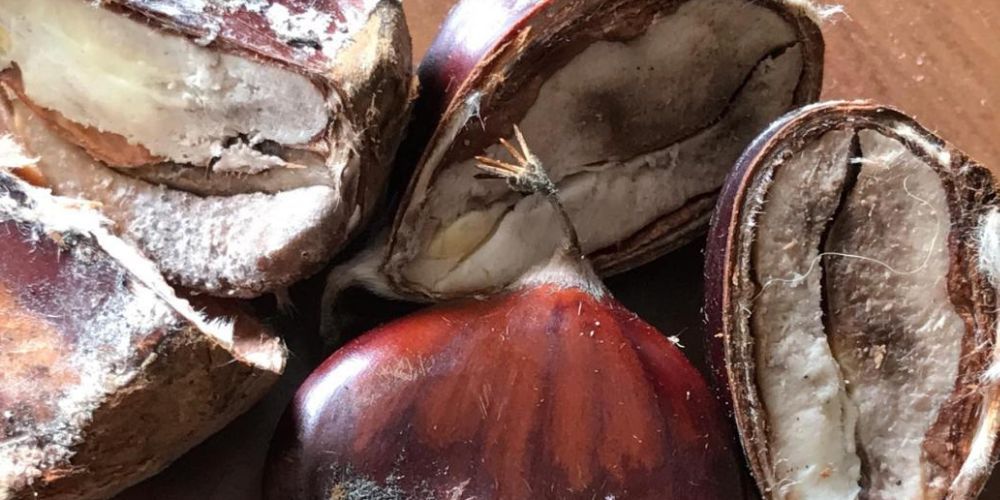
Brown rot (also known as chestnut chalk rot) is a fungal disease that has been present in our country for some time now.
In recent years, however, Gnomoniopsis Castaneae is becoming more and more impactful on productions.
The first symptoms of brown rot manifest themselves, close to harvesting, on the fruits with initial browning that over time leads to a hardening of the endosperm (which becomes white and chalky).
The epidemiology of this pathogen is not fully known to date. It lives as an endophyte on plant vegetation and is preserved on plant tissues, in particular on "hedgehogs".
Therefore, it is of paramount importance to eliminate (when possible) plant residues in post-harvest.
Our suggestion is also to perform a copper-based treatment before vegetative resumption, through:
- Cupravit BLU 35 WG (dosage: 200 g/hl)
In particular, it is essential to intervene from the post-fruit set phase onwards (2-4 treatments) with copper-based products, which enter into the system with the plant. In this case, we recommend using:
- Kyprion (dosage: 250 ml/hl)
***
***
- FERTILIZATION IN ORGANIC FARMING-
For the organic cultivation of a chestnut grove, our advice is to use
- Kendal (dosage: 200 ml/hl) which, thanks to its antioxidant function, increases the resistance of the plant in hostile conditions and in case of stress
Phytophthora Chinamoms and Phytophthora Cambivora - Inksickness
***
***
Cydia Splendana and Cydia Fagiglandana - Chestnut Lepidoptera
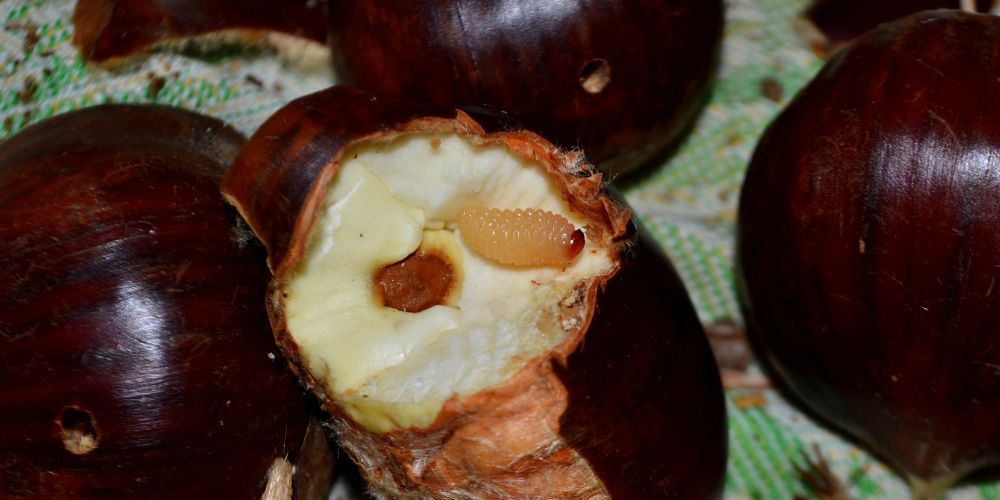
The damage caused by chestnut moths is caused by Cydia Splendana and Cydia Fagiglandana in their larval stage. During this phase, in fact, the insects dig tunnels inside the fruit which, following the damage, cannot be marketed.
In order to effectively and efficiently position the treatments, during the month of June it is advisable to install:
- Supertrak wing monitoring traps (and related pheromones)
Indicatively, it will be necessary to install 3-4 traps/hectare for each species that you want to control.
When the intervention threshold is exceeded (consult the production specifications of your region of reference) you can intervene with:
- Vesticor (dosage: 20ml/hl)
If you don't have a license, you can use Turi-L at 200 ml / hl.
Share this content


 Chronology
 Citrus fruits
 Turf
 Stone fruit
 Olive tree
 Ornamental
 Vegetables
 Actinidia (Kiwi)
 Screw
 Hobbies and insights
 Pome Fruit


