
Your cart
There are no more items in your cart
How to protect plants from frost
Categories :
, Chronology
Protecting crops from frost is an activity that, if carried out preventively, will certainly lead to a greater and satisfactory result. The most extensive damage is found during spring frosts, when the crops, upon waking up after winter, have begun any activity (e.g. floral development phase, new vegetative hunts) or when the icy winds dehydrate the green parts. Especially in these phases, the new fabrics risk being seriously compromised.
What actions can we take to protect crops from frost?
Index
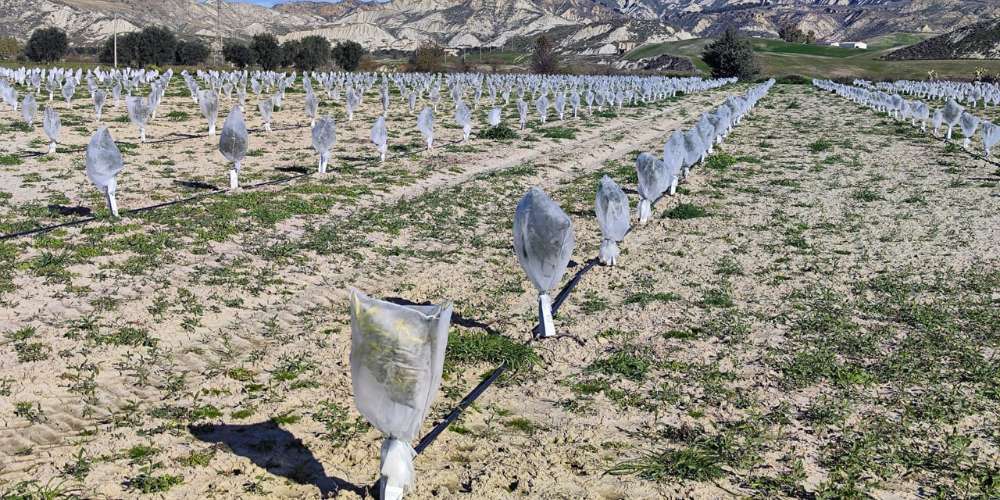
Antifreeze film for plants - TNT -
TNT - non-woven fabric:
Non-woven fabric (TNT) can reduce the temperature difference between the inside and outside by 1 or even 2 degrees, which is very effective in particular for defending vegetation from the action of the wind.
TNT is highly recommended on horticultural and fruit crops, especially on young plants.
On young citrus crops, on the other hand, we recommend using TNT caps from December until February-March. Before hooding the plants, however, our advice is to treat them with a potassium-rich algae, such as:
The purpose of such treatments is to increase the resistance of the plant throughout the winter period.
As far as horticultural crops are concerned, there are TNT "sheets" of different sizes, capable of covering the plants and thus allowing the temperature inside the sheet to be maintained greater than 2-3°.
Below, we list the various models of plant defrost sheet available:
- Tubular climate tube (available in different diameters and lengths. The tube must be cut to the size of the plant and then closed at the ends)
- Non-woven hood
- Protex Non-woven fabric STOCKER 4736 h 2 x 20m (roll to be rolled out or used as desired)
- Protex- STOCKER Hood (available in different formats and sizes)
- Ortoclima Non-woven fabric (suitable for both open field crops and inside unheated greenhouses)
Would you like to receive our advice? Subscribe to our Newsletter - 8% discount now for you
|
Protection of crops from frost: physicochemical defense
We can consider a form of physico-chemical defense the use of:
- vegetable waxes or resins (such as Vapor Gard, Nu-Film)
- chemical waxes (such as IOS ICAS)
- vegetable oils (such as Soy Lecithin 80, Soy Oil Max 85, Mastro 50. In addition, in addition to an invigorating effect, these oils also have a physical effect, thanks to the oil film that is created on the vegetation)
Together with these products, the addition of fertilizers and microelements, such as:
In addition to increasing the salinity and therefore the thermal resistance of the film created by the oils, they nourish and strengthen plant cells, increasing the salinity of the cytoplasm of the cell and linfa.
This practice ensures a good duration conditioned only by the concentration of the products used. It should be remembered that the solutions indicated above must be used in the imminence of the event and require a good and uniform coverage of the vegetation.
The maximum result would be obtained with a double pass, crossing or reversing the direction of advance. In addition, it should be remembered that in the case of a mixture of vegetable oils with very alkaline substances, it will be necessary to acidify the solution.
... DEFENSE WITH KILLER FROST...
A practical and effective solution consists of defensive actions, through the use of:
Potassium glycol-based fertilizer which, by quickly entering the cells and into the linfa, lowers the freezing point and allows the vegetation to pass the critical phase. The dose of use, as well as the uniformity of wetting, is a fundamental element.
Doses for:
Fruit crops: 600-1000lt/ha
open field horticultural crops: 300-500lt/ha
in greenhouse: 100l/1000m2
The defensive action is very fast and subsides in a couple of days. Therefore, it is necessary to intervene whenever the calamitous event is announced.
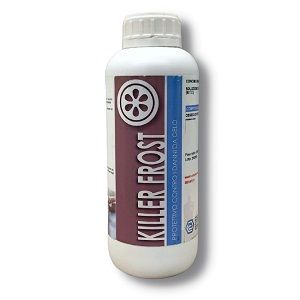
The ease of use of Killer Frost, combined with a reasonable price, makes this product also suitable for hobby use. It is a fertilizer that can be used on all crops, fruit or ornamental, and which, in addition to defending the vegetation, releases potassium (a very important element for plant health). In addition, Killer Frost is an alkaline product and, as such, is also able to have a good action against fungi and bacteria.
However, mixtures of waxes or vegetable oils with fertilizers, although less practical and more expensive, offer a number of other advantages. Let's take an example with a mixture composed as follows:
Such a mixture combines the shielding effect of Vaporgard with the action, typical of the Trazer, of increasing the salinity of the cell. In addition, thanks to the presence of zinc, it thickens the cell membrane. The laminarin contained in MC Extra, on the other hand, is perceived by the plant as an alarm. Thanks to this, the plant will develop its own defenses, thickening the cell membrane and thus having a real physical action.
When frost affects plants with fruits (such as oranges or lemons), thinking of inducing resistance with systemic products will not be wise, since the ripe fruit does not possess sistemia. In this case, our advice is to intervene with:
The objective of this intervention is to ensure thermal protection, defense against dehydration and nutrition at the epidermal level, to preserve the turgid, healthy and shiny skin. In addition, the Vaporgard will create an anti-perspirant membrane on the fruit, so as to prevent dehydration.
We would like to remember that all the tools we can use are palliatives. In fact, if temperatures drop significantly and for many hours, the means at our disposal will be significantly reduced.
Watch the live with the L.G.ITALIA expert:
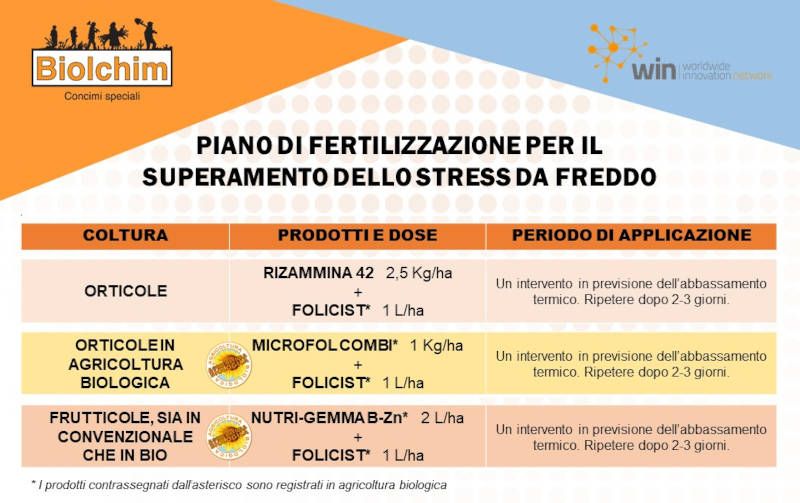
Below are the treatments recommended by Biolchim:
Share this content


 Chronology
 Citrus fruits
 Turf
 Stone fruit
 Olive tree
 Ornamental
 Vegetables
 Actinidia (Kiwi)
 Screw
 Hobbies and insights
 Pome Fruit


