
Your cart
There are no more items in your cart
What is NPK fertilizer used for? What it is and how to use it
Categories :
Hobbies and insights
Index
What is NPK fertilizer and what is it used for?
.jpg)
Introduction
We often talk to you, answer your questions, and ask ourselves together what are the best choices to make to ensure that your crops live healthily and ensure an optimal yield. Thus, it happens to discuss methods of combating various pests and diseases or to talk about nutrition plans. It is precisely in this last macro theme that some of the questions that, lately, you ask us very often:
What is NPK fertilizer? What is it for? What is the best npk fertilizer?
NPK fertilizers in agriculture
If for the first and second questions the answer is very simple, for the third, however, we need to go into a little more detail: the choice of the best NPK fertilizer, in fact, depends on the type of crop we intend to fertilize and what are the goals we want to achieve. In the course of this article we will try to explore, through a synthesis, everything that revolves around this topic, to then get to recommend the best NPK fertilizer according to your needs.
Let's start from the beginning...
We all know that a well-nourished plant is a plant that can cope with the entire production cycle in the best possible way: making sure that the plants have the right amount of nutrients, therefore, will be beneficial not only for the health of the plant, but also for the yield that you yourself expect from it. NPK fertilizers, for example, are divided according to their titration, i.e. the amount of elements contained within them.
Thus, you can find 20.20.20 fertilizers (which will provide a perfectly equal dose of both nitrogen, phosphorus and potassium) or fertilizers that are more unbalanced towards one or the other macro-elements. Obviously, it is not enough just to feed a crop, but it is necessary to pay close attention to the amount of nutrients we administer to it: excessive doses or deficiencies would lead to extremely unfavorable results. As part of the broader nutritional discourse, NPK fertilizers play a fundamental role. Let's see why.
What is NPK fertilizer and what is it used for?
NPK fertilizer is a product, usually chemical, that is used to provide the plant with nitrogen (N), phosphorus (P) and potassium (K), the three macro-elements fundamental for the nutritional needs of each crop. Each of these macro-elements acts on a specific part of the plant, contributing to its healthy development:
- Nitrogen (N) is crucial for healthy and vigorous plant growth, playing a vital role in photosynthesis. An excess of nitrogen will make the plant more fragile and more prone to attack by pests or the development of diseases, to the detriment of the final harvest. A deficiency of this element, on the other hand, causes stunted growth of the plant and, consequently, a much less abundant harvest. It is important to underline that this element has a limited persistence in the soil, which makes fertilization necessary several times. For this reason, we recommend using a slow-release NPK fertilizer, which will allow the plant to absorb nutrients at the exact moment it needs them.
- Phosphorus (P) is essential for the formation of roots, as well as for promoting the photosynthesis process. It is therefore very important that the plant draws on its source of phosphorus in all its phenological states, from birth to its production phase. A plant that does not have enough phosphorus available is weak, its roots struggle to grow, and its flowering is delayed.
- Potassium (K) is vital for water absorption, as well as for the water balance of the plant itself, which will develop good resistance to temperature changes and possible diseases. Potassium also acts on increasing production as well as improving the color, flavor and texture of the fruits. However, a potassium deficiency weakens the plant, damaging root formation.
Going back to the starting point of nutrition in general, we can now add one more piece. To be really sure to offer our crops complete and balanced nutrition, we will have to take care to provide not only nitrogen, phosphorus and potassium but also a whole series of other miso-elements (such as boron, phosphorus, calcium, magnesium or iron) according to nutrient needs. It is from this need that the addition of other microelements within some NPK fertilizers derives.
This is the case, for example, of:
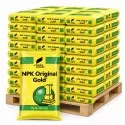
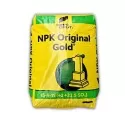
- NPK Original Gold 15.9.15 (formerly Nitrophoska gold)

In addition to nitrogen, phosphorus and potassium, the former Nitrophoska gold contains microelements, such as:
- Magnesium, an essential component of chlorophyll that helps plant growth
- Sulphur, important for the production of amino acids and for the water balance of the plant
- Iron, used for the formation of chlorophyll
- Zinc, a useful element of auxin, which is one of the main hormones of the natural growth of the plant
NPK Original Gold contains 5% nitrogen with controlled release. This allows not only a reduction in the number of fertilizers useful for the supply of this element, but at the same time limits its volatization in the environment. The nitrogen contained within NPK Original Gold comes in nitric form, this to allow the plant to have this element ready for use.
Would you like to receive our advice? Subscribe to our Newsletter - 8% discount now for you
|
How to choose NPK fertilizer?
As we mentioned at the beginning of our discussion, the amount of nutrients needed by the plant varies according to the type of crop, the phenological phase and the objectives to be achieved. NPK fertilizers for bottom fertilization tend to be used only in the vegetative recovery phase because the plant needs energy to be able to start again. Each crop prefers an NPK fertilizer with different titration:
For the olive tree, for example, our advice is to proceed with:

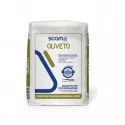
The titration of Olive Grove (10.5.6) is designed specifically for the olive tree: the nitrogen it contains, in fact, is protected by organic matrices and this allows to spur the renewal of the vegetation, increasing the drupe to obtain the maximum oil yield. If we are faced with dense plants, then we can proceed with open-field fertilization. In the case of large plants, on the other hand, it will be advisable to distribute the npk fertilizer located in the area of projection of the crown. The doses to be used vary from 2 to 6 kg per plant, depending on the year of charge or discharge, the vigor of the plant, the presence or absence of organic fertilizer and the quantity of production. However, if we have plants characterized by a strong alternation of production, it will be better to increase the dose of Olive Grove, up to double it, if necessary.
For citrus fruits, we suggest using:
.png)
It is an NPK fertilizer that is more unbalanced in nitrogen, an element that citrus fruits need most during the vegetative recovery phase. Thanks to the addition of calcium and magnesium, we will also be able to increase the photosynthesis process and improve the appearance of young fruits. In addition, it is a slow-release resin-coated fertilizer and this characteristic allows a gradual release of the elements, making them available to our plants for up to 30-60 days.
For stone fruit plants, we prefer to use:
.png)
For these crops, we tend to administer a higher amount of phosphorus (towards which this particular type of NPK is unbalanced), in view of the shorter cycle of stone fruits compared to other tree crops.
For turf, we recommend that you include two types of NPK fertilization in a broader nutritional program:
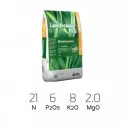
The first, to be carried out at the spring vegetative resumption (February-March). In this case, it will be useful to proceed with LandscaperPro Mantenance, an NPK fertilizer with a more unbalanced titration in nitrogen to improve the photosynthesis process and ensure better growth.

We suggest that you irrigate your lawn after applying fertilizer. In this way, you will speed up its absorption, accelerating the greening process of your lawn. The Poly-S controlled release technology also ensures that nitrogen is released gradually for 2-3 months and that the product is available for the entire phase of the active restart of growth.
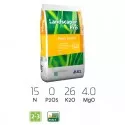
In the periods leading up to the peak of summer growth (May-June), our suggestion is to use LandscaperPro Stress Control , a npk fertilizer higher in potassium
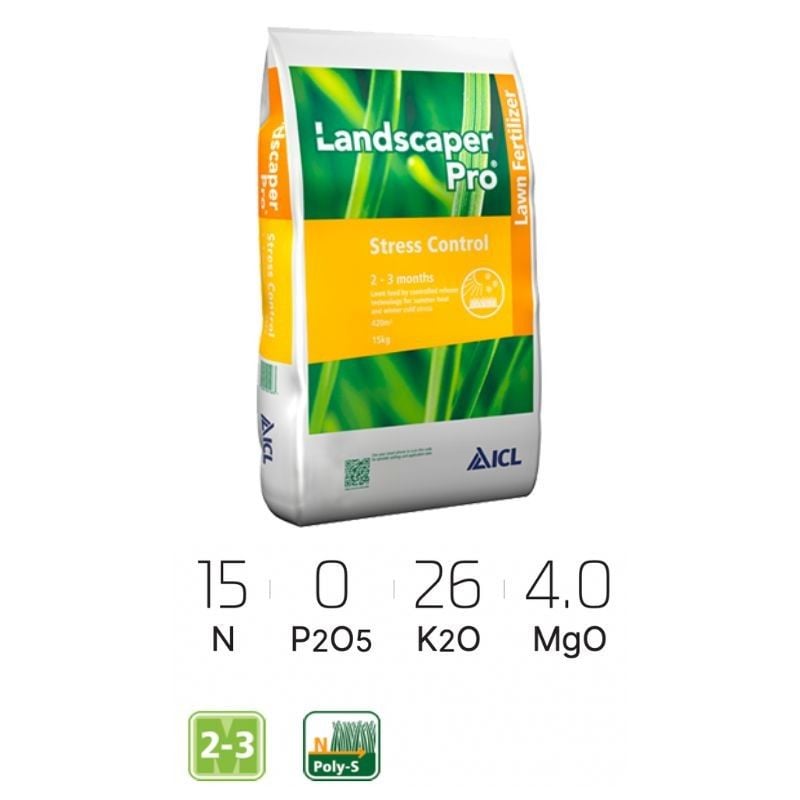
In the transition to the summer season, the turf risks suffering stress due to temperature changes. A higher potassium content, therefore, by increasing the salt concentration in the lawn, will help it to better cope with periods of greater fatigue. By acting on the turgor of the cell and enlarging it, LandscaperPro Stress Control will also make the turf more resistant to trampling.
How to use NPK fertilizer?
Let's start by saying that NPK fertilizer can be used in fertigation, by foliar application (powder or liquid NPK fertilizers) or through a bottom fertilizer (granular NPK fertilizers). The choice of the type of fertilization depends a lot on the state of the plant:
- Fertigation, for example, is preferred when the crop is already active, able to assimilate water and, therefore, also capable of absorbing the nutrients we administer to it.
- Foliar fertilization is, basically, among the fertilizers with the fastest absorption, but also the one most subject to the dispersion of nutrients. Therefore, when foliar application, it will be advisable to make sure that the plant is in vegetative awakening.
- Bottom fertilization with granular NPK fertilizers, on the other hand, is a type of nutrition with slower assimilation and, therefore, it is preferred to implement it in winter, in the vegetative rest phase. In this way, we will be sure that when it wakes up, the crop will have absorbed the necessary elements and will be ready to face its development and production phase.
When to use NPK fertilizer?
It must be considered, however, that there are 3 different types of NPK fertilizers, each of which follows a more or less standard fertilization period. Specifically, there are:
- - Mineral NPK fertilizers to be administered in spring, when the plant faces its maximum degree of nutritional need
- - organo-mineral NPK fertilizers, they are given in the vegetative recovery phase (late winter-early spring) and in addition to providing nutrients, they provide organic matter*
- - Organic NPK fertilizers to be administered mainly in autumn/winter. This way, the plant will be able to absorb nutrients in spring
*Discover our article on The importance of organic matter in agriculture
Share this content


 Chronology
 Citrus fruits
 Turf
 Stone fruit
 Olive tree
 Ornamental
 Vegetables
 Actinidia (Kiwi)
 Screw
 Hobbies and insights
 Pome Fruit


