
Your cart
There are no more items in your cart
Growing avocados: entry into production and defense
Categories :
Chronology
.jpg)
Starting an avocado production is a practice that requires attention, especially in consideration of the type of soil that the plant needs and the particular climate it prefers. In Italy, the areas where the crop is particularly widespread are Sicily, Calabria and Sardinia. However, also because of its profitability, avocados are a rapidly expanding crop. Precisely for this reason, it is essential to pay particular attention to the time of entry into production of the crop.
Index
Entry into production of the crop
Avocado plants: phytosanitary defense
Floral biology and pollinator placement
***
***
Entry into production of the crop
From Spain, where cultivation started for the first time, there has been feedback on the need to carry out few treatments on this specific crop. However, it is advisable to carry out punctual and targeted ones in precise phenological phases.
December
We will start ouravocado management program in December, distributing an organo-mineral fertilizer at the bottom, under the canopy and slightly buried:
- Orga-kem 6.11.8 +10Ca0 (dosage: 1.2kg /plant depending on size)
January
In this month, we plan to intervene through foliar fertilization rich in copper and zinc, elements that induce resistance to fungal pathogens, as well as providing initial nutritional support to the plant:
- Welgro Cu + Zn (dosage: 2 kg/ha)
February
Starting from February, it will be essential to administer calcium and magnesium, two fundamental elements that become part of the cellular constituents and that strongly influence the qualitative aspects of the final production. Then, we will proceed with fertigation:
- Nova Plus CalMag (dosage: 50kg/ha)
May: Fruit enlargement phase
During this phase, it will be advisable to intervene with:
- Organor N12 (dosage: 250g/100lt)
- Loess Ca (dosage: 250g/100lt)
With the use of Organor, a fertilizer with a high content of auxins, cytokinins and vitamins, we will stimulate the growth of the fruit. Loess Ca, on the other hand, will serve us to provide the plant with the necessary amount of calcium, which is particularly useful in this phase
***
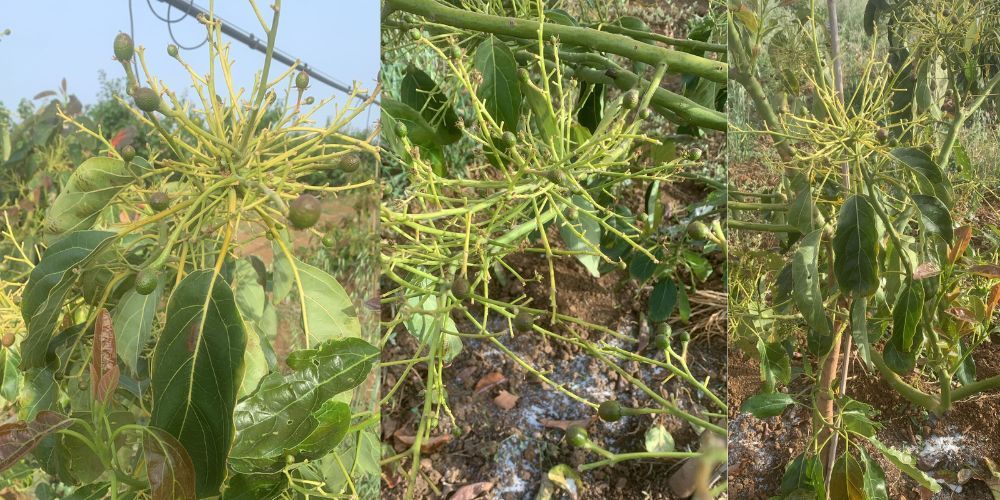
Avocado fruit set: the most important phase
The fruit set phase of the avocado is crucial for a good yield. The entire flowering-fruit set phase, in fact, will not be satisfactory if the plant is not supported by a series of elements, which we will try to provide by foliar application.
In the pre-flowering phase, we recommend intervening, using elements such as boron, molybdenum:
- Extra molibor (dosage: 200gr/hl)
- Haifastim promo (dosage: 100gr/hl), with stimulating action
In the flowering phase, our suggestion is to intervene with:
- Organor N12 (dosage 250gr/hl)
- Glibor ca (dosage: 250ml/hl)
In the post-flowering phase, we will use:
September is the period of formation of the roots necessary, of course, for the absorption of water and nutritional elements. For this reason, our advice is to intervene with fertigation through the destruction of O.S.:
- Ecogreen (dosage: 12.5 litres/ha)
Finally, if the aim is to increase the size of the fruit, it is possible to intervene with
- Chelal Noor (dosage: 300gr/hl)
At the end of the production cycle, in the post-harvest phase, we recommend intervening in fertigation, in order to collect the amount of nitrogen for the beginning of the year. The product we suggest is
- Tionamm (dosage: 100kg/ha)
... SIXTHS OF PLANTS ...
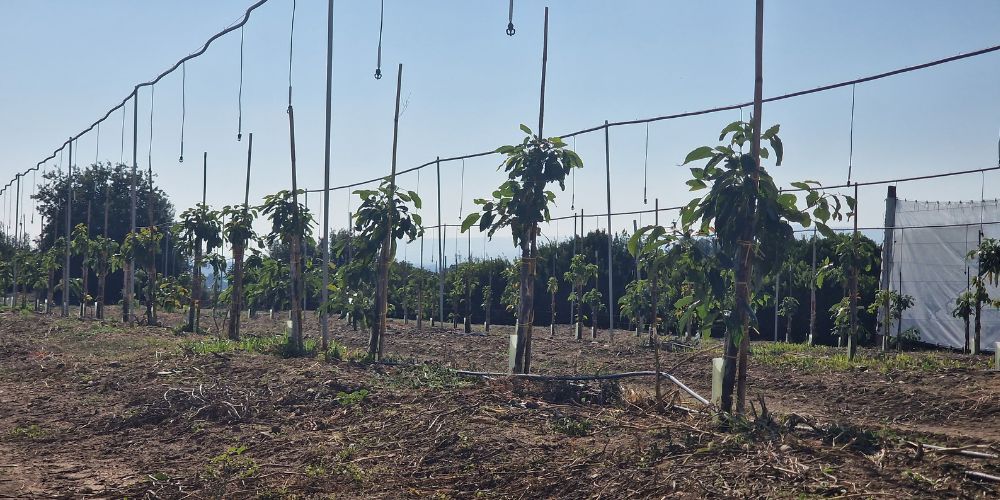
In defining the planting layouts, it must be considered that the avocado is a very vigorous plant and that, under normal conditions, it can easily exceed 10 meters in height.
To date, two schemes are mostly adopted:
- The first scheme is the Spanish one , which provides for a distance between the rows of 6-8 m and a distance on the row of 4-5 meters
- The second scheme is the Israeli one , where dynamic layouts on trunks are envisaged that provide for an inter-row distance of 5-6 meters and one on the row 2-3 meters
***
***
Avocado plants: phytosanitary defense
As far as phytosanitary defense is concerned, to date there are very few products registered on this crop. Precisely for this reason, it is advisable to intervene in prevention. The product we recommend is
- Kyprion (dosage: 200ml/q.le)
NEEDS AND PRECAUTIONS TO BE TAKEN DURING CULTIVATION
During the feasibility assessment of the investment, an essential parameter to be evaluated is the soil and climate conditions of the potential cultivation site.
Experiences in the cultivation of this crop in Italy have shown that avocados prefer medium-textured soils. Going into more detail, to avoid irreversible problems, especially in the early stages of development,the clay content must be less than 30%.
In addition, strong winds and low temperatures are an additional stress factor for the crop.
***
***
Floral biology and pollinator placement
The avocado is a plant characterized by a particular biological mechanism, designed to prevent self-fertilization. This characteristic forces us to combine the main variety with a pollinating variety in the field. The pollinating cultivar must be present in 7-10% to ensure sufficient pollination. The avocado is an entomophilous pollinated species characterized by a very low pollination rate (0.8-1%).
Share this content


 Chronology
 Citrus fruits
 Turf
 Stone fruit
 Olive tree
 Ornamental
 Vegetables
 Actinidia (Kiwi)
 Screw
 Hobbies and insights
 Pome Fruit


