
Your cart
There are no more items in your cart
What is Zeolite used for in agriculture?
Categories :
Chronology
Index
Micronized zeolite, how it acts on tissues and leaves
Would you like to receive our advice? Subscribe to our Newsletter - 8% discount now for you
|
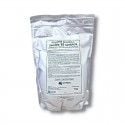
Micronized zeolite rock powder with multiple properties
Introduction
Zeolite is a mineral that in nature originates from volcanic magma which, falling into brackish water, undergoes thermal stress and solidifies quickly.
This mineral unleashes its potential when it is "activated" thanks to micronization, a process that allows it to be transformed into a very fine powder made up of microporous particles.
Distributing this powder over plant tissues creates a hydrophobic layer (which repels water).
Thanks to this characteristic, zeolite is used as a corroborant capable of increasing the resistance of plants to pathogens such as fungi, bacteria, phytoplasmas, insects and mites.
Being an inert material in itself, it is allowed to be used without limitations. Zeolite can be used in Organic Farming and is harmless to humans, beneficial insects and aquatic organisms.
Micronized zeolite, how it acts on tissues and leaves
Zeolite is also used in viticulture. The protective veil that is created on the leaf surface creates a hydrophobic patina that hinders inoculation and consequently the proliferation of fungi and bacteria.
Thanks to the particular structure of the particles that compose it, if distributed on vegetation, it creates confusion for the visual and tactile receptors of insects, which are unable to recognize the target plants. In this way we have a reduction and localization of the damage especially by:
It hinders the movement of eryophyid mites, consequently also limiting their damage, thanks to the lamellar and needle-like shape of the particles that compose it;
The reproduction of mites is significantly limited, since the eggs, laid on the thin layer of microparticles, do not develop.
Dehydrating action
It has a strong dehydrating and solution-absorbing action, facilitates the healing of plant tissues in the case of wounds caused by biotic and abiotic factors such as:
-
hail
-
cultivation practices
-
Fruit harvesting
-
insects
-
Growth and bud breakage
It reduces the damage caused by the sun because it is distributed on the vegetation and filters the "harmful" rays without limiting photosynthetic activity;
(see also the article on the blog: How to avoid CITRUS SUNBURN)
The persistence of pesticides and in particular of sulphur-based copper products and pesticides increases to a variable extent, limiting their leaching and better distributing the particles.
For copper products, the effect can be prolonged up to 10-12 days longer than conventional treatment, and it also allows the use of the minimum dose indicated on the label.
Zeolite Foliar Doses
Light interventions that do not dirty against gray mold, to improve the shelf life and shelf life (period of time in which a food can retain its qualitative characteristics) of the fruit even during harvesting:
-
150-300 grams per hectoliter
Preventive interventions of total coverage, or winter treatments together with coppers:
-
from 400 to 600 grams per hectoliter.
Share this content



 Chronology
 Citrus fruits
 Turf
 Stone fruit
 Olive tree
 Ornamental
 Vegetables
 Actinidia (Kiwi)
 Screw
 Hobbies and insights
 Pome Fruit


By enzobianchera@inwind.it 2019-08-18 22:20:09
Posso pagare in contrassegno? Risposta : il contrassegno non è previsto