
Your cart
There are no more items in your cart
The pine processionary moth
Categories :
Chronology
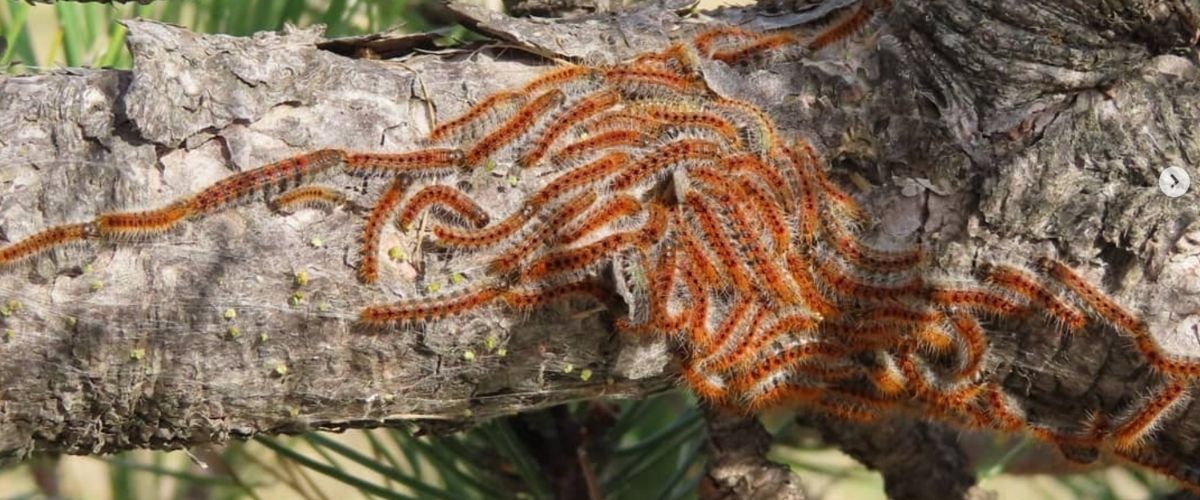
Among the best known insects harmful to ornamental plants, there is certainly the pine processionary moth (Thaumetopoea Pitycampa): a butterfly that attacks conifers and is also particularly annoying for humans and pets.
For the public health of people who frequent public and private parks or gardens, as well as for the maintenance of the plants themselves, it is essential to keep the processionary moth under control through special treatments, which fortunately can be carried out with effective but at the same time environmentally friendly products.
Index
Thaumetopoea Pityocampa: how to recognize it
Pine processionary: the damage
Pine processionary: how to eliminate it
Strategies for fighting with processionary traps
***
***
Thaumetopoea Pityocampa: description and spread of the pine processionary moth
The processionary moth (Thaumetopoea pityocampa) is a moth that completes a single generation per year. The adults, with crepuscular-nocturnal habits, appear in summer and it is possible to recognize them by observing the characteristic stocky body with white and light brown wings.
The female processionary moth lays from 100 to 300 eggs and the larvae are about 4 cm long; they have gregarious habits and feed on the leaves of the pine or other conifers on which they are found.
You will be able to recognize the females of Thaumetopoea Pitycampa by their black head and grayish back equipped with many hairs collected in tufts; the legs, on the other hand, are yellow.
The reason why the insect is called processionary is linked to the fact that the larvae, walking all attached and in a row one behind the other, form a sort of procession, hence "processionary".
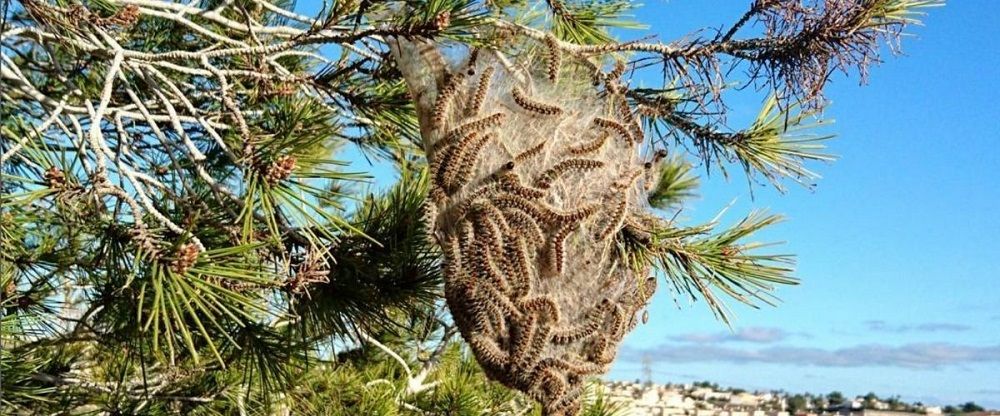
The presence of this insect in some phases of its cycle is easily identifiable: in winter, in fact, you can see their nests on the foliage of the pines, which consist of clusters of whitish cobwebs, formed in the areas most exposed to the sun and therefore easy to see.
***
***
Damage from processionary moths
The direct damage of the processionary moth on plants is linked to its trophic activity, at the expense of pine needles and throughout the larval phase.
Pine trees heavily infested with Thaumetopoea Pitycampa can even defoliate completely. However, milder but continuous infestations over the years also have a very negative effect. In fact, a plant already weakened by a parasite is certainly more predisposed to further attacks, such as those of other insects or pathogens that cause secondary damage.
Damage to plants is therefore an excellent reason, in itself, to justify phytosanitary defense interventions.
However, the pine processionary moth is mainly associated with the annoyance it causes to people and pets. It is mainly the larvae of the third age, in the last stage, which with the presence of stinging hairs, can cause epidermal and allergic reactions, even strong.
Seen under the microscope, these hairs appear equipped with harpoon-like needles and serve the insect as a protective strategy against predators. The problem is that the hairs easily detach from the body of the larvae to fly away carried by the wind, and this means that direct contact with the insect is not necessary to have skin discomfort, because the hair can fall on people and animals.
Given the characteristics of this insect, a territorial fight is planned through the regional Phytosanitary Services in coordination with the municipal administrations, but in the private sector it is important to know how to behave and what to do, while avoiding the use of potentially aggressive insecticides.
Prevention
If you are near pines or other conifers heavily infested by processionaries, it is good to avoid certain gestures, such as approaching, stopping for a long time and even hanging out the laundry nearby, because the stinging hairs could fly away and stick to the clothes.
If you grow vegetables or fruit trees nearby, it is important to wash the crop thoroughly using gloves, to avoid any contact with these hairs.
It is also necessary to avoid collecting the nests to destroy and burn them as with this gesture the very high risk is to favor the spread of hair in the air. The processionary moth nests that can be seen are in fact those of mature larvae with hairs, while those of young larvae are those that are not yet so easily seen.
***
***
Treatments to eliminate the pine processionary moth
Treatments against the pine processionary moth can be carried out using products with low environmental impact, non-polluting and non-toxic. Depending on the time of the insect's cycle, it will operate in different ways:
In autumn, it is possible to find first-age larvae, which have not yet developed stinging hairs and are not yet dangerous. In this case, it is possible to treat with products based on Bacillus Thuringiensis Kurstaki, such as:
- Lepinox PFNPE
- Xentari WG (license required)
The larvae of processionary moths that feed on the treated vegetation, in fact, suffer from the toxins of Bacillus, which are activated thanks to the alkaline pH of the intestine of these insects. Bees, as well as other useful or harmless insects, are spared. The product is also easily biodegradable and leaves no residues in the environment.
***
***
Strategies for fighting with processionary traps
Processionary traps are a valid means of fighting. Depending on whether the insect is in its adult phase (butterfly) or in its larval stage, it will be necessary to place 2 different types.
But when to put the traps for processionaries?
Let's find out together...
Fight against adults
During the warmer months, once the chrysalises are opened, the adults of Thaumetopoea pityocampa will begin to flicker. The goal of the fluttering of the male processionary becomes, therefore, to mate.
In this case, the purpose of the trap is to prevent adults from reproducing. Our advice is to use:
- Super Green, taking care to place it in the months from May to September
Fight against larvae
In the coldest period of the year, the processionary moth larvae have entered the most mature phase and, for this reason, they have already developed stinging hairs. In descending from the trunk to find refuge in the ground, it is very easy (both for humans and pets) to come into contact with these hairs and suffer damage.
To combat processionary moth larvae, therefore, it will be necessary to place in the months from January to March:
In the case of logs with a larger diameter and circumference, you can use a special extension
... OUR ADVICE..,
In the period from winter to spring, our advice is to avoid approaching the plants if there is the presence of processionary moth larvae. Generally, in public parks, specialized personnel take care of the treatments and are equipped with all the necessary Personal Protective Equipment, but those who see nests can always report them to the competent office of their municipality.
In summer, there are old nests on the pines that still contain stinging hairs, so it is good to avoid intervening on your own and behave as in winter and spring.
In summary, the optimal period for phytosanitary treatments for the pine processionary moth is autumn, when interventions, even repeated, with Bacillus thuringiensis are effective. Although it is an eco-sustainable substance, it is still important to take all the precautions and indications that can be read on the label, for careful and responsible use, and always wear Personal Protective Equipment during execution.
Share this content


 Chronology
 Citrus fruits
 Turf
 Stone fruit
 Olive tree
 Ornamental
 Vegetables
 Actinidia (Kiwi)
 Screw
 Hobbies and insights
 Pome Fruit


