
Your cart
There are no more items in your cart
The cultivation of the almond tree
By :
TANCREDI MAURIZIO -
Categories :
, Chronology
, Stone fruit
In recent times we have been hearing more and more often about almonds: a crop that, slowly, is making its way both in the world of professional agriculture and in that of hobby agriculture. Knowing the cultivation strategies, therefore, is necessary to guarantee the cultivar its maximum yield.
Index
How to fertilize the almond tree: bottom fertilization
How to transplant the almond tree

Over the last few years, the cultivation of the almond tree has taken on the dignity of a cash crop: the uses of the fruit are varied and the cultivation needs must therefore increasingly aim at better results.
This production was boosted, among other things, by the widespread consumption of snacks based on this fruit. For this reason, almond cultivation has become intensive and now requires specific and punctual agronomic care, such as fertilization, supplementation and treatment.
It is a very special crop, because, even if it does not require many operations, it requires a certain punctuality in interventions. Therefore, our advice is to carry out few interventions, as long as they are positioned in particular and certain phenological phases.
The almond tree is also a stone fruit and, therefore, should be treated as such, even if it needs less drastic pruning and less frequent irrigation. It should also be considered that the plant prefers draining and not asphyxiated soils. Where this is not possible, our advice is to set up a bed to the ground, to allow the water to drain quickly, avoiding possible stagnation.
***
***
The adult almond tree
September/October: POST-HARVEST PHASE
Our approach to this new crop aims to include in the strategy products allowed in organic farming and integrated farming, with the help of resistance inducers. The goal is to improve procedures and, by ensuring synergies between the products used, to obtain the maximum yield.
The first activity to be included in this new strategy is an intervention that will allow the buds to be nourished, nitrogen to accumulate in the woody organs and, through boron and zinc, to have a homogeneous and quality flowering. We recommend a particular formulation of copper (Coptrel), which has a systemic action and will help to have a plant more resistant to pathogenic attacks.
Intervene with an under-canopy fertilization, through the use of:
- Granular Tionamm (dosage: about 500gr per plant)
By carrying out a foliar treatment:
- Inex-A (dosage: 30ml/hl)
- Phylen (dosage: 300ml/hl)
- Zintrac (dosage: 100ml/hl)
- Bortrac (dosage: 100ml/hl)
- Coptrel (dosage: 50ml/hl)
October/November
At this stage, we recommend the use of:
- Inex-A (dosage: 30ml/hl)
- Kendal-Tea (dosage: 250ml/q.le)
This intervention aims to disinfect the wounds after harvesting and to promote the ripening and fall of the leaves (prematurely inducing the dormancy of ripening.
November/December (preferably in the post-pruning phase)
During this period, we recommend the use of:
- Cobre-Nordox (dosage: 250gr/hl)
- Layer (dosage: 100ml/hl)
It is an intervention composed of a copper with a fungicidal action, mixed with Layer, a particular type of product useful for capturing copper molecules and keeping them in contact with the parts of the plant much longer.
January/February
In this phenological phase, we recommend increasing the defense with a contact fungicide with an essentially preventive action against blister and corineous:
- Inex-A (dosage: 30ml/hl)
- Ziramit 76 WG (500gr/q.le)
***
***
How to fertilize the almond tree: bottom fertilization
Bottom fertilization is an important procedure to integrate part of the nutrients that will be removed from the crop during the vegetative-reproductive phase. This phase can be improved with fertigation interventions.
1st bottom fertilization in January:
- Vigor Top 60 (500gr/plant)
Calendar of phytosanitary and nutritional interventions Almond
PRE-FLOWERING phase
The almond tree is particularly sensitive to blistering and prone to aphid attacks. For this reason, it will be necessary to take care to control its development and to intervene, in the spring period, with:
- Inex-A (30ml/hl)
- Merpan 80 WDG (150-200g against bubble and moniliosis)
- Epik SL (150ml against aphids)
Beginning of February: Treatments against overwintering eggs of aphids, mealybugs and mites
- Oliocin Plus (dosage: 4-5lt/hl)
It is essential to ensure uniform wetting of all parts of the plant to be sure of an excellent insecticidal result (in particular against aphids, which are tenacious hosts of almond trees).
Our advice is not to delay the treatment beyond the first days of February, given the possible early awakening of the almond tree.
Puffy Almond Bud (Pre-Flowering)
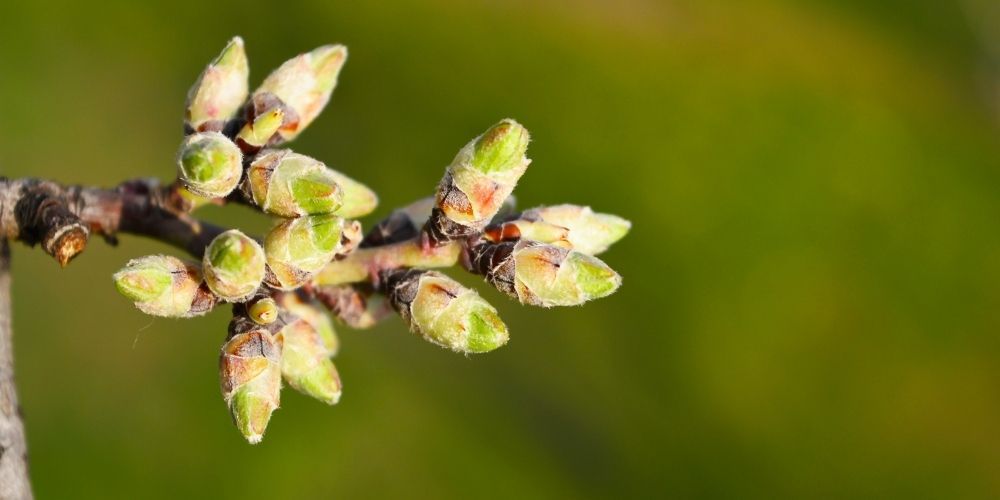
The vegetative activity phase begins where, in addition to the defense against bubble and monilia, we try to administer a substantial dose of macro and micro elements that are very useful for flowering and fruit set:
- Inex-A (30ml/ql)
- Merpan 80 WDG (200gr/hl)
- Loess Ca (200ml/hl)
- Welgro Complex (200gr/hl)
- Vitaseve (500ml/q.le)
The addition of Vitaseve will give a strong boost to lymphatic circulation and an injection of energy to cells stressed by abiotic agents.
Flowering stage
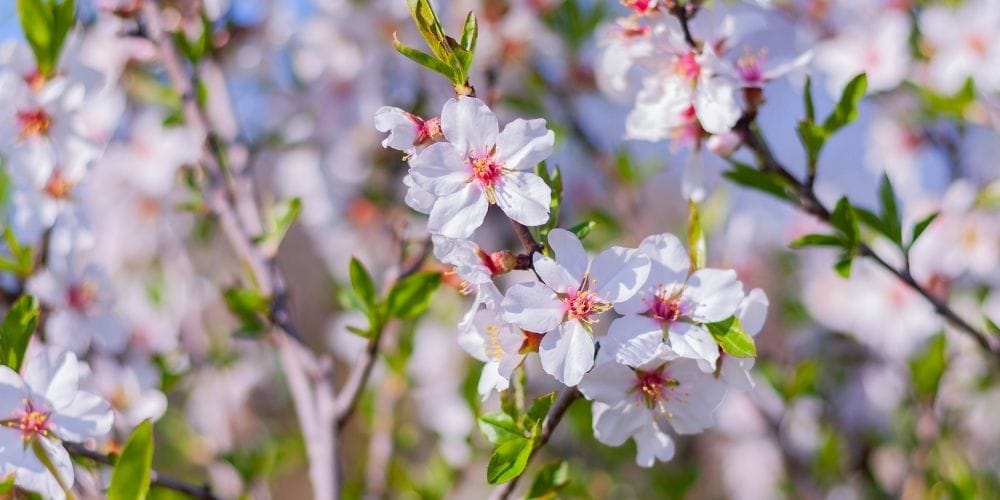
At this stage, it will be very important to provide plants with boron and calcium-based microelements. For this reason, our advice is to intervene with:
- Glibor Ca (dosage: 200ml/hl)
... THE BACTERIOSIS OF ALMONDS ...
With climate change, upheavals of phenological phases are observed.
In the useful years, moreover, it is possible to notice new fungal attacks that are confused with corineum or rust, but which we know to be bacteriosis.
Certainly, the idea that good and balanced nutrition is the necessary condition to allow the plant to strengthen its self-defenses against these new pathogenic attacks is rightly reinforced. For this reason, it is a good idea to carry out 1-3 interventions immediately after flowering depending on rainfall.
With new pathologies also come new strategies: we begin to discover the virtues of a new blend of products based on silver, zinc and oxygen peroxide ions:
Fruit set/pinafore phase
At this stage, it is important to intervene against monilia which could be caused by the failure of the flower petal to detach from the fruit. It is also good to keep the chorineum and powdery mildew under control. The strategy we recommend is:
- Inex-A (dosage: 30ml/hl)
- Signum (dosage: 80-100gr/hl)
- Triplex (dosage: 200gr/hl)
- Mc Extra (dosage: 100gr/hl)
Fruit enlargement phase
In this situation, in addition to intervening to improve the enlargement, we recommend adding preventive products against monilia, corineo, powdery mildew and bulla):
- Inex-A (dosage: 30ml/hl)
- Signum (dosage: 80-100gr/hl)
- Triplex (dosage: 200gr/hl)
- Mc Extra (dosage: 100gr/hl)
N.B.
Carry out a swollen bud treatment and one at the beginning of flowering. The punctual execution of these tips will ensure a healthy plant, abundant productions and excellent fruit quality.
***
***
How to transplant the almond tree
After years of experience and field trials, Perfarelalbero has developed a strategy that strengthens and protects the plants, avoiding their blockage after the critical phase of planting.
Usually, in fact, the plant undergoes transplant stress, due to the change in soil and climatic conditions, such as the transition from the "muffled" and protected situation of the nursery, to the condition of the open field; the change of terrain, winds, rains etc.
The operation we recommend is to make a mixture of two granular products to be administered directly during the transplanting operation in the hole, before placing the almond plant in its home:
- Micosat F Uno (dosage: 10-20 gr per hole)
- Prodigy Plus (dosage: 50-100 gr per hole)
The function of this mixture is to stimulate the production of the plant's self-defenses, such as to ensure root protection and rapid general development.
In the case of plants already planted, you can use these fertilizers for almond fertigation in a mixture:
Post-transplant foliar interventions
After transplanting, the goal will be to provide good vegetative development to the plant. For this reason, we recommend two basic interventions to alternate, to protect and nourish the small seedlings.
Alternate the two interventions even every 15 days:
INTERVENTION 1:
- Kendal-Te (dosage: 200ml/100lt)
INTERVERT 2:
- Agroleaf 31.11.11 (dosage: 250gr/100lt)
Share this content


 Chronology
 Citrus fruits
 Turf
 Stone fruit
 Olive tree
 Ornamental
 Vegetables
 Actinidia (Kiwi)
 Screw
 Hobbies and insights
 Pome Fruit


By Vale 2021-05-13 08:27:03
Buongiorno, che differenza c’è tra i prodotti consigliati scritti in verde e quelli scritti in nero? Grazie ---- RISPOSTA--- : Quelli in verde se cliccati portano alla pagina del prodotto.
By Vale 2021-04-26 16:27:40
In merito ai saponi di potassio, ho già provato anche più di un trattamento a giugno ma non sono riuscito a contenerli, la var. Tuono dicono sia più sensibile a questa cimice. Grazie
By Vale 2021-04-26 16:25:21
Quindi anche Asset o Pyganic possono andar bene essendo dei piretroidi? Alcuni agricoltori mi hanno detto di provare con una polvere di roccia, pensi possa funzionare? Grazie ---- RISPOSTA ---- : I saponi di potassio, ad una azione fisica devono sommare una repellenza verso i parassiti, questa peculiarità appartiene ai saponi di origine vegetale e non tutti. Indicare genericamente con il nome di sapone di potassio è fuorviante, ne stiamo utilizzando 2 con discreto successo, uno Mastro 50, miscibile anche con zolfo, un altro Combo. Chiaro che se si interviene con un forte attacco in corso occorrerà oltre che bagnare molto bene, anche ripetere se il caso. L'estratto di piretro (lo sono i due prodotti citati da lei), è efficace e abbattente e dopo poco tempo sparisce; se non si è fatta pulizia il problema può ritornare. Suppongo che lei si riferisca a prodotti autorizzati in agricoltura biologica, Altra cosa sono i piretroidi, Decis, Karate , ecc, che non sono ammessi in agricoltura biologica, ma che hanno una buona efficacia contro cimici.
By Vale 2021-04-26 07:16:10
Buongiorno, il vostro programma dettagliato e ben fatto termina con la fase relativa all’ingrossamento dei frutti. Purtroppo da maggio in poi iniziano ad arrivare le prime colonie di Monosteira Unicostata, potreste cortesemente consigliarmi il trattamento ( se uno o più) da fare sia in biologico sia in convenzionale? Grazie --- RISPOSTA --- Buongiorno, sono diversi i prodotti chimici che si possono utilizzare : Kaimo, Decis Evo, e altri piretroidi, se invece vuole fare una difesa biologica le suggerisco Mastro 50 a 500 cc/hl oppure Combo a 500-600 cc. Occorre una buona bagnatura per colpire l'insetto.
By Raffaele Divincenzo 2020-11-30 23:03:06
Il mio più che un commento è un ringraziamento. Sintetici, preparati e gentili...sto spulciando tutto il sito web e ne sono innamorato. Un grazie sincero Raffaele