
Your cart
There are no more items in your cart
Stone fruit moths
Categories :
Chronology
, Stone fruit
Index
How to fight them? Biological and integrated pest management
Would you like to receive our advice? Subscribe to our Newsletter - 8% discount now for you
|
Stone fruit moths: how they strike and how to defend themselves
If you have a peach, apricot or plum tree then you will surely have learned about these unwelcome guests. But do you really know how they work? In jargon we call them "worms" but they are nothing more than lepidopteran in the larval state that infest the fruits of our stone fruits.
While butterflies are completely harmless, larvae are of great concern and pose a real threat to stone fruit crops.
Eastern moth and Peach moth
"Cydia molesta" or "Oriental moth" : preferentially attacks peaches "Anarsia lineatella" or "Peach moth" : attacks mainly peaches and apricots but also plum trees "Cydia funebrana": attacks only plum trees.
How do they act?
The moths first hit the shoots, of which there is a drastic drying of the vegetative apex, then they move on to the flowers, drying up these too and then they arrive at the fruit, through deep tunnels from the petiole to the stone, where they settle to feed on the pulp, favoring the development of mold and rot, making it inedible and depreciating the productions.
The attacks take place in spring or early autumn but it is important to know that during the winter the eggs of the moths remain inside the fruiting buds and inside them they can complete an average of three life cycles (egg-larva-chrysalis)
How to fight stone fruit moths? Biological and integrated pest management
Sexual confusion is the ideal weapon in the biological control of the moth and does not involve, under normal conditions and normal infestation pressure, any chemical intervention.
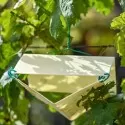
It is necessary to place some traps for capture and monitoring, 2-3 per hectare in particular in the perimeter area, and one or two (depending on the type) plant dispensers, dispensers that release large quantities of female sexual pheromones into the field that confuses the males thus inhibiting mating and reproduction, and therefore the deposition of fertile eggs by the females.
We want to remind you that their effectiveness must be verified, however, with the help of the traps for capture and monitoring previously installed, it will be necessary to check daily and verify the catches which, if below the critical threshold of two or three per day, it is not necessary to intervene in the insecticide chemical.
Phytosanitary treatments
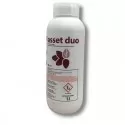
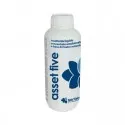
In the event that the catches are beyond the alarm threshold, it is necessary to intervene chemically with natural pyrethrum, Asset or Asset Five, allowed in organic and with very low chemical residues. For a traditional defense, insecticides will be used, also in this case it is advisable to use monitoring traps in order to identify the best time to carry out the treatment. This method makes it possible to drastically reduce the number of interventions with undisputed economic and environmental advantages. In order not to frustrate its use, we recommend placing the dispensers at the beginning of the setting so as to allow us to identify the times and duration of the individual cycles of the insect.
Our experience and knowledge of the different mechanisms of action of the products leads us to distinguish the treatments on stone fruits by generational phases of the moth:
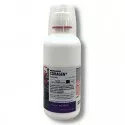
- Start of the flight: i.e. in the egg laying phase it is necessary to use ovo-larvicide products such as: Chlorantraniliprole (Coragen),
Emamectin, Benzoate (Affirm), Spinetoram (Exalt).
- During the flight: it will be necessary to counter, as necessary, with mainly insecticide products: Chlorantraniliprole (Coragen), Emamectin benzoate (Affirm), Spinetoram (Exalt), Thiacloprid (Calypso).
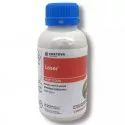
In this phase, the choice may also fall on very effective larvicide biological products such as Spinosad (Laser), Bacillus thuringiensis (Xentari).
We remind you that if in the pre-harvest phase, which for stone fruits embraces a very varied period of time, treatments for the defense against the fruit fly are carried out with Etofenprox (Trebon- no plum), or pyrethroids (various), these will also have an action in the control of cydia with a predominantly adulticidal action. In organic farming, the fight against the Mediterranean fly will have to make use of different techniques and means.
We have therefore talked about integrated pest management, made with the use of chemical but also biological products, the choice and evaluation of which will be made according to the different needs, observing the plants, knowing the life stages of the moth to measure its times and plan interventions in order to make the most of its effectiveness and aim for a reduction in pesticide residues, considering in this regard the increasingly stringent demands of large-scale distribution, the sensitivity of the consumer and last but not least the increasing awareness of the agricultural operator who cares about the health of the ecosystem.
Share this content


 Chronology
 Citrus fruits
 Turf
 Stone fruit
 Olive tree
 Ornamental
 Vegetables
 Actinidia (Kiwi)
 Screw
 Hobbies and insights
 Pome Fruit


