
Your cart
There are no more items in your cart
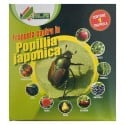
How to fight Popillia Japonica?
Categories :
, Chronology

Popillia Japonica Newman (Coleoptera Rutelidae) is a voracious beetle belonging to the beetle family. It is a polyphagous insect and newly introduced. Its first appearance in Italy, in fact, dates back to 2014 in the regions of Piedmont and Lombardy. The larvae have been transported, in Italy as in other European countries, on packaging, agricultural products and also through the trade of ornamental plants. Unfortunately, there are numerous cultivable species sensitive to the attack of this insect. These include fruit trees, ornamental species and lawns.
Throughout this article, after talking about how to recognize the beetle and the main damage caused, we will try to offer you some useful strategies to combat it.
Index
How to recognize Popillia Japonica?
How to eliminate Popillia Japonica larvae?
***
***
How to recognize Popillia Japonica?
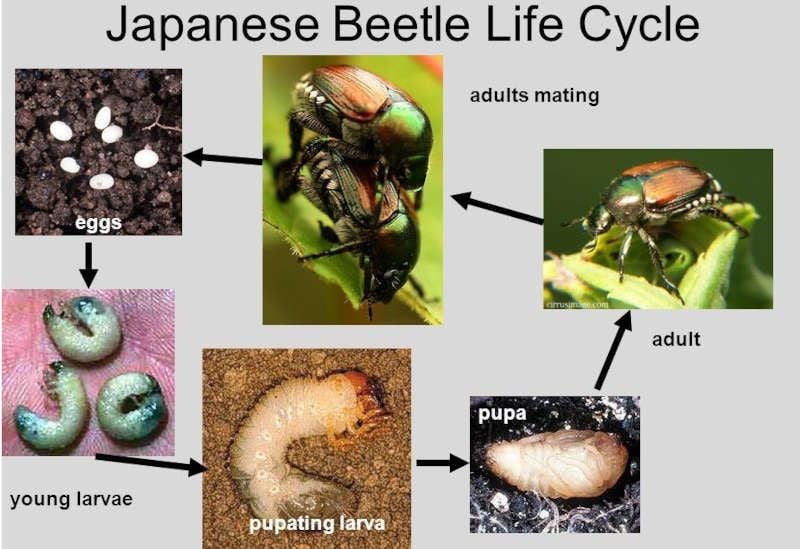
In its adult stage, the male Popillia can be recognized by its typical metallic green color. The female, on the other hand, is usually larger in size and is characterized by the presence of white tufts on the abdomen and on the final part of the elytra.
The adults of Popillia feed on cultivated, ornamental and spontaneous plants. Like all insects in the same family, this beetle spends most of its life in the state of hypogeal larva, living in the arable layer of the soil and feeding on roots and tubers.
Females usually lay their eggs in the ground, although sometimes they may dig small tunnels in which to deposit their eggs.
What are the damages?
Popillia Japonica causes damage to both its larval and adult stages. As a larva, the beetle causes damage only to the roots. In the adult phase, on the other hand, damage is found on fruits, flowers and leaves. While flowers and fruits will be almost completely destroyed, the leaves will be browned (only the central vein will be intact), with the possibility that they will detach from the tree or remain, albeit skeletonized, attached to the plant.
Damage to lawns, on the other hand, manifests itself with yellowing and wilting, with the appearance of black spots. In the case of particularly strong attacks, the entire lawn could have irreversible damage.
***
Would you like to receive our advice? Subscribe to our Newsletter - 8% discount now for you
|
***
How to eliminate Popillia Japonica larvae?
We would like to emphasize that the fight against the larval form of Popillia can only be carried out through the use of antagonistic entomoparasites .
A very effective and decisive strategy is the one that involves the use of:
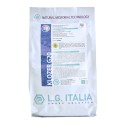
A pack of 50 million individuals will allow you to treat an area of 100 square meters. To use Larvanem, you will need to dissolve the amount in 3-4 liters of water, and then add water up to enough to treat the area to be reclaimed. After the treatment, proceed with the necessary irrigation to convey the nematodes in contact with the ground.
In addition, it must be considered that the mating of Popillia takes place from the end of May in the warmer areas and until the end of July in the colder areas, with the consequent hatching of the eggs about two weeks after egg-laying.
Moist and soft soils (such as lawns) and land cultivated with vegetables and in any case not irrigated are those preferred by females who, digging a small tunnel, lay 1 to 3 eggs inside. After laying, the female Popillia emerges and is already ready for a new mating.
The fight against the larvae must be carried out at least 15-30 days after the appearance of the adults.
Fight against the adult of Popillia Japonica
The fight against the adult of Popillia Japonica, which generally feeds in areas far from those of oviposition, is more effective in obtaining an immediate result. The strategy, carried out with foliar treatments, involves the use of 3 products mixed with each other:
- Control Dmp (dosage: 50ml/hl)
- Epik SL (dosage: 200ml/hl)
- Inex-A (dosage: 30ml/hl)
Alternatively, you can use an additional strategy that, although it will require a longer period of time, will certainly have an effect:
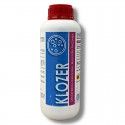
Mebov FR stimulates and promotes the development of fungi such as Beauveria bassiana and Metharizium Anisopliae, parasitic agents of Popillia Japonica. Klozer and Mebov FR are both without ministerial registration, do not leave toxic residues and do not impact the environment.
The Klozer + Mebov mixture can also be sprayed on turf, before proceeding with irrigation to convey the fungi into the soil. In the latter case, the dose of Klozer will be 30ml/hl and that of Mebov 30ml/jl.
Pheromone trap fight for Popillia Japonica
A further means of combating the adults of this beetle is represented by the use of traps and pheromones for mass capture, such as:
How does the trap for Popillia Japonica work?
Sayonara Trap works thanks to a pheromone bait and a special attractant. Their combined effect attracts the beetle inside the specific container, preventing it from escaping. Thanks to the chromotropic color of which the trap is made, the specimens of Popillia Japonica will be more attracted to it.
CASE STUDY: THE FARMER'S EXPERIENCE
In addition to the interventions described so far, we want to tell you about an experience made personally by one of our customers to fight Popillia.
Following a consistent attack, which occurred first on the roots and then on the leaves of his peach and blueberry plants, our customer carried out insecticide interventions for Popillia Japonica, without however obtaining the desired results.
Given the situation, our advice was to carry out a treatment with Laser, an insecticide based on Spinosad (30ml/hl) also allowed in organic farming together with an adhesive capable of improving the insecticidal action, at doses of 30ml/hl.
The treatment was carried out on 4 rows of peach trees and 10 blueberry plants, leaving 1 row of peach trees and 4 blueberry plants untreated and as a comparison.
Our client repeated the intervention after 7 days and managed to stop the activity of Popillia Japonica on the treated plants
Share this content




 Chronology
 Citrus fruits
 Turf
 Stone fruit
 Olive tree
 Ornamental
 Vegetables
 Actinidia (Kiwi)
 Screw
 Hobbies and insights
 Pome Fruit


