
Your cart
There are no more items in your cart
How to fight pomegranate aphids?
Categories :
Chronology
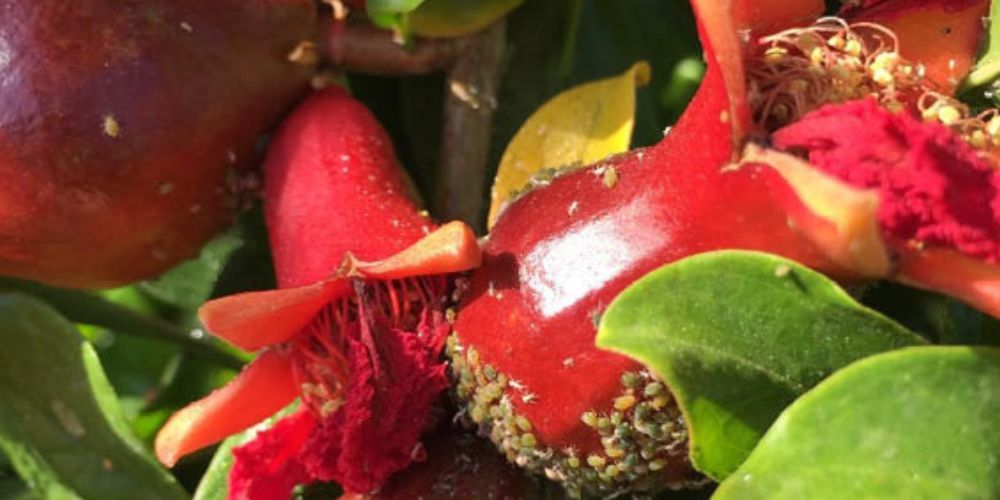
Aphis Punicae Passerinii and Aphis Gossypii are among the most dangerous pests for pomegranate plants, making it necessary to take preventive and control measures to limit damage to the crop as much as possible.
Index
How to fight pomegranate aphids
Would you like to receive our advice? Subscribe to our Newsletter - 8% discount now for you
|
Although a possible infestation of both Aphis punicae passerinii and Aphis Gossypii begins in spring, coinciding with the development of new shoots, the two pomegranate lice behave extremely differently. Let's start by saying that while Aphis Gossypii is a polyphagous aphid, which attacks malvaceae and curcubitaceae, Aphis Punicae instead is a monophagous aphid, properly typical of the pomegranate tree.
Precisely for this reason, while the first phytophagous develops its colonies starting from its winged shape (recognizable by the green color of the abdomen and the black head and thorax), the colonies of Aphis Punicae Passerinii, on the other hand, begin from the founders born from the eggs previously deposited directly on the pomegranate plant.
As temperatures rise, colonies begin to grow, peaking around the first half of May. In fact, during the flowering period, buds, flowers and fruits will suffer a real infestation. When the shoots harden, the two pomegranate parasites, due to their differences, will have two different behaviors:
- Aphis Gpssypii will abandon the pomegranate plant, to migrate to new plants
- Aphis Punicae Passerinii will continue to remain on the tree throughout the summer
The damage caused by both species of aphids is extremely significant
.jpg)
The high amount of linfa removed from the plant, which drastically reduces its photosynthetic activity, is one of the main consequences of attack by both pests. In addition, the most common problem after an aphid attack has to do with the production of honeydew, a direct consequence of discolored areas on the fruit, with subsequent depreciation of the final product. Further damage is:
- Premature fruit drop
- Vegetation dieback
How to fight pomegranate aphids
Whether it is a real pomegranate crop or a plant grown in the garden, our advice is to implement a defense against aphids mainly in prevention. To date, in fact, there are no specific active ingredients registered on this crop, so once the infestation has already occurred it will be very difficult and problematic to be able to eradicate any outbreaks. With this in mind, we will recommend targeted bio strategies for both professionals and hobbyists.
PROFESSIONAL STRATEGY
Prevention phase
January-February VEGETATIVE REST
The first operation we suggest, taking care to always implement it during the vegetative rest period (winter) and in any case never beyond the "enlarged bud" phase, is to use products based on paraffinic mineral oil, such as:
Polithiol (5L/q.le) which, thanks to its broad spectrum of action, guarantees protection not only against aphids, but also against pathogenic insects and fungi.
Vegetative recovery phase
During this phase, our advice is to intensify interventions with collateral and generic actions such as the use of zeolite :
Zeolite 95 (1kg/ha) which, in addition to a hydroscopic and deterrent action, makes plant tissues inhospitable due to a possible attack.
A real strategy against the attack of pomegranate aphids consists in the use of beneficial insects, such as:
Aphiscout , able to control and contain the action of harmful parasites in a completely natural way, minimizing the consequences of their attack
We recommend cutting branches with the presence of an outbreak.
At the first honeydews and therefore in the presence of very little aphid, we suggest intervening, preferably in the evening to ensure longer-lasting effectiveness, with:
Soptech (100ml/100L. We recommend doubling the volume of water, to allow the product a higher yield.). Its greatest action against the aphid is to peel off the honeydew, washing it + Chemol (500ml/100L - variable according to temperature-), a white paraffinic oil which, acting by asphyxiation, prevents the aphid from breathing.
About 7 days after this intervention, it will be possible to proceed with a further launch of useful insects.
UNPROFESSIONAL STRATEGY
Again, our advice is to initially proceed with a specific zeolite-based treatment:
Zeolite 95 (1kg/ha), to fortify the plant and make it inhospitable to lice attacks.
Further interventions with a view to prevention or in the presence of some outbreaks may be the use of:
Vebi nettle (50gr/10L) : which, in addition to having a fertilizing effect, has a strong repellent odor against aphids
white vegetable soybean oil (30ml/10L), whose function is similar to that of white oil
Kappa-o (20ml/10L), induces repellency and has a mechanical suffocation action on the aphid
Soft soap (20ml/10L) that has a "cleaning effect" on plants smeared with honeydew, without leaving any residue.
We suggest integrating these interventions with the use of antagonistic insects. Even within domestic environments such as gardens, in fact, the practice of throwing is widespread, given its simplicity.
Share this content


 Chronology
 Citrus fruits
 Turf
 Stone fruit
 Olive tree
 Ornamental
 Vegetables
 Actinidia (Kiwi)
 Screw
 Hobbies and insights
 Pome Fruit


