
Your cart
There are no more items in your cart
The white mealybug on the KIWI Pseudaulacapsis pentagona
Categories :
Actinidia (Kiwi)
, Chronology
Index
How to fight the white mealybug of Actinidia

The white mealybug of Actinidia Pseudaulacapsis pentagona
Introduction
The kiwi, of which Italy is the largest producer in the world, is a climbing plant.
Among its major pests we have the white mealybug (Pseudaulacapsis pentagona). This pest attacks both arboreal and herbaceous and belongs to the Rhynchota family, which is the family of phytophagous insects such as mites and aphids.
The insect
The white cochineal prefers plants that are not very humid and poorly ventilated. For these pests, warm environments favor their vigor, increase their reproduction and their ability to infest.
It feeds on the linfa and obtains it by piercing the leaf blade, stem, cord, shoots and fruits, slowing down their growth.
There are symptoms that the plant manifests when it is infested with this parasite, and they are:
- yellow, withered, spotted leaves,
- presence of ants attracted by honeydew (waste substance of cochineal).
These insects are organisms that need a lot of protein substance. The protein substance is extracted from the linfa and a sugary substance is produced as a waste substance, which then forms honeydew. Honeydew attracts ants (the presence of ants can be a wake-up call for the presence of cochineal), and this sugary substance could also attract other fungal organisms that would carry diseases.
If you find a solid and clear shield on the plant or fruit (which with the presence of this shield is considered unmarketable) here is the nest of the cochineal inside which there are both adults and eggs and from there they dig to extract the linfa.
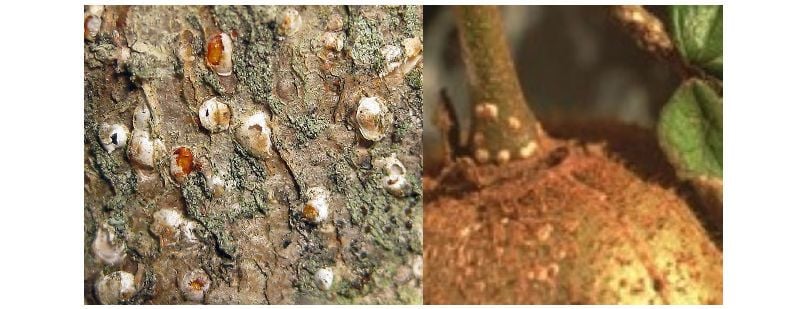
The most attacked species of actinidia is the yellow-fleshed one because being hairless these parasites are able to attach and feed better, while the green-fleshed one being tomentose, brings a little more problems to the parasite and is attacked less.
These parasites complete several generations in a calendar year; the males have wings and they are the ones who move to find the female specimens, while the females are born without wings and in some species, after laying their eggs, they also lose their legs.
Mealybugs rarely kill their hosts, but with their infestation, the plants deteriorate with the subsequent drying of the branches and, more importantly for farmers, produce little.
Would you like to receive our advice? Subscribe to our Newsletter - 8% discount now for you
|
How to fight the white mealybug of Actinidia
Already normally in adulthood they are very resistant to normal pesticides but if they form the nest or the famous "shield", there you will no longer be able to reach them with any pesticide because it is composed of a substance that makes it hard and impenetrable by insecticides, for this reason we recommend:
- Mineral oil (with different trade names OLIOCIN, CHEMOL): for ORGANIC Farming, it is used in the phenological phase of bud enlargement; It is an oily substance to be sprayed on plants. It adheres with a coating on parasites and eggs, acting by asphyxiation. It is usually not used in summer because this patina decreases leaf transpiration, risking creating burns on the leaves. Our product Oliocin can also be used in summer but with reduced doses. In winter the dose is 4 kg/hl, while in summer we reduce up to 2-2.5 kg/hl. The 500 ml pack of Biankoil is free for sale, while for larger packs there is the need for a license.
- POLITHIOL: it is an insecticide-acaricide (to be used as an alternative to oliocin), mineral oil with the addition of sulphur, which is used in the phenological phase of bud enlargement with a dose of 5 kg/hl.
- BIOBACTER as a strategy to eliminate cochineal on kiwi in "organic farming". We recommend the use of BIOBACTER with a dosage of 200-300 ml per hl of water. It is a "zero residue" zinc-based fertilizer, which can be used at any stage of the crop. It manages to weaken the insect's shield, and by mixing it with other insecticides we will thus be able to solve the problem.
The use of traps
We always recommend the use of the SUPER TRACK WING TRAP for a better result. It is a hut that attracts insects through a pheromone (to be purchased separately), positioned in the center, in order to monitor the peak of the flight and at that moment treat with insecticide.
It is positioned 1.5 meters from the ground and importantly, remember to change the pheromone every month even if it has not completely discharged to have a better and safe effect.
Share this content


 Chronology
 Citrus fruits
 Turf
 Stone fruit
 Olive tree
 Ornamental
 Vegetables
 Actinidia (Kiwi)
 Screw
 Hobbies and insights
 Pome Fruit


