
Your cart
There are no more items in your cart
Boxwood borer Biological control - Cydalima perspectalis
Categories :
Chronology
, Ornamental
Of Asian origin accidentally introduced in Italy, Cydalima perspectalis is quickly becoming a real problem for boxwood, threatening the plants of nurseries and many Italian gardens. After describing both the larvae and the adults of this insect, we will suggest some useful strategies to combat it
***
***
Boxwood borer: biological cycle
Cydalima Perspectalis, also known as Diaphania Perspectalis or Glyphodes Perspectalis, lays its eggs in groups, partially surmounted one on top of the other, below the leaf page. Initially pale yellow in color, the eggs turn brown with maturation, allowing a glimpse of the forming and blackish head inside.
Once the eggs hatch, the boxwood borer larvae come out with a yellowish-green color with characteristic black bands and thin white streaks along the body. The larvae reach up to 4 cm in length and feed on the leaves and shoots of the boxwood for about a month until ripe. If the attack is consistent, the complete defoliation of the plants can be determined.
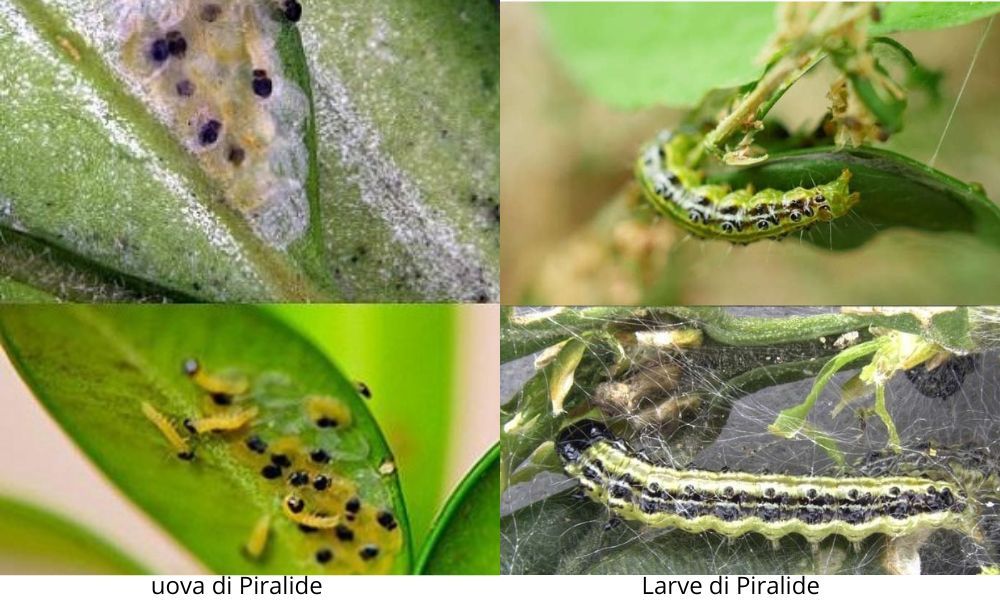
The green chrysalises with black stripes along the dorsal part measure about 2 cm and then become a hazelnut, dark brown color. They can be found within vegetation, wrapped in a whitish cocoon well hidden among vegetation. They can be found within vegetation, wrapped in a whitish cocoon well hidden among vegetation.
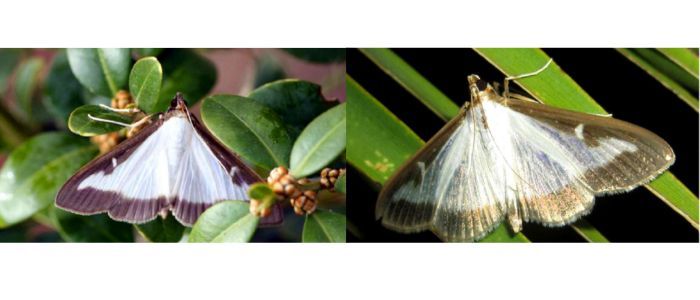
The adult borer, on the other hand, is a white butterfly with a wingspan of 4 cm and wings with gray-brown bands on the edges. In Italy it has three to four generations a year and overwinters as a larva in a cocoon woven in autumn among the leaves. The following year, with average temperatures above 12 degrees, the larva completes its development, pupates and flickers to start the first generation. Thanks to its flight capabilities, it is able to quickly colonize new areas but to conquer distant areas it does not disdain a "hitchhiking". This means that areas very far from those of origin can be reached on boxwood plants infested with eggs, larvae and pupae, from other countries.
***
Would you like to receive our advice? Subscribe to our Newsletter - 8% discount now for you
|
***
Boxwood borer: remedies
The fight against the boxwood caterpillar is carried out through a particular type of bacterium naturally present in the soil: Bacillus Thuringiensis. This bacterium is practically harmless to humans and beneficial insects. Precisely for this reason, in agriculture, Bacillus-based products can be considered irreplaceable insecticides both for the home garden and for many cash crops.
When to carry out the treatments?
The treatments must be carried out in spring, in the period in which the overwintering larvae resume trophic activity, and then be repeated at each generation. In this way, it will be possible to keep the number of individuals constantly low. For targeted use, it is advisable to monitor - using pheromones.
Technical advice: monitoring to decide on defense treatments must be a current practice which, although a bit challenging, helps to decide the moment of interventions, allows you to avoid unnecessary interventions with significant economic savings and lower environmental impact.
Professional Defense Strategy:
- Control DMP (dosage: 50-80ml/hl)
- Xentari wg (dosage: 150g/hl g/hl)
Xentari WG is a selective biological insecticide against beneficial insects and pollinators. Our advice is to evenly wet the vegetation and repeat the treatment every 7 days, taking care to apply the product in the coolest hours of the day, preferably in the evening. Bacillus Thuringiensis works well at neutral pH. Therefore, to ensure its maximum effectiveness and avoid having to repeat the treatment, it is essential to acidify the pH of the water used in solution with the DMP Control. In addition to acting as an acidifier, Control DMP improves the absorption capacity of your borer treatment thanks to its surfactant action that increases leaf wettability.
Defense strategy without a license:
- Control DMP (dosage: 50-80ml/hl)
- Lepinox (dosage: 10g/10l)
Boxwood borer: biological control in gardens and urban environments
After the recent review of products for non-professional use, Italian chemical laboratories have developed solutions that act indirectly against the boxwood moth. Among these, we tested the effectiveness of:
- Turi-L - WITHOUT LICENSE- (dosage: 20ml/10l)
Turi L is a fertilizer containing mycorrhizae, with a strong ability to preserve and increase the development of the Bacillus population. Acting by ingestion, it consistently reduces the presence of larvae of the boxwood borer (as well as any other type of moth that is a source of problems for agricultural and ornamental crops). Our advice is to use it by sprinkling and to repeat the treatment, to maintain its effectiveness, on a regular basis every 5-7 days, as long as the problem persists (from early spring until June)
If you want to take the path of conventional treatment , we recommend the use of:
- Acetamiprid
- Ferticus Copper Sulfur (dosage: 50ml/10L)
Share this content


 Chronology
 Citrus fruits
 Turf
 Stone fruit
 Olive tree
 Ornamental
 Vegetables
 Actinidia (Kiwi)
 Screw
 Hobbies and insights
 Pome Fruit


