
Your cart
There are no more items in your cart
Microelements in the garden
Categories :
Chronology
, Ornamental
, Turf
Index
The advice of the Landscape Agronomist: Microelements in the garden
How do the symptoms of micro-deficiencies manifest themselves?

The advice of the Landscape Agronomist: Microelements in the garden
If there is one aspect of plants that we have learned since childhood, it is that they transform light energy into chemical energy through the process of Photosynthesis.
Nutrients are essential for the plant to grow, develop and reproduce. The availability of nutrients in the soil, on the other hand, is not always able to meet the demands of the plant itself, which is why they are administered through fertilization.
But what, then, are these nutrients?
A necessary distinction must first be made:
- Macroelements: present in higher quantities in the soil (Nitrogen, Phosphorus, Potassium).
- Microelements: less present but equally important, such as Iron (Fe), Manganese (Mn), Zinc (Zn), Copper (Cu), Boron (B), Molybdenum (Mo), Chlorine (Cl) and Nickel (Ni).
Often passed over on the sly, microelements enjoy the exact same importance as macroelements and a lack of the same causes significant imbalances for the plant, which are transforming, within our garden, into loss of color, turgor and productivity, greatly affecting the aesthetic and qualitative appearance of the plant and the entire garden. As an example, it is useful to report that a lack of Molybdenum (the least represented microelement) is able to prevent the assimilation of Nitrogen.
From the moment the first symptoms are observed on the plants, it is necessary to act promptly through urgent and targeted fertilization.
Would you like to receive our advice? Subscribe to our Newsletter - 8% discount now for you
|
But how do the symptoms of micro-deficiencies manifest themselves?
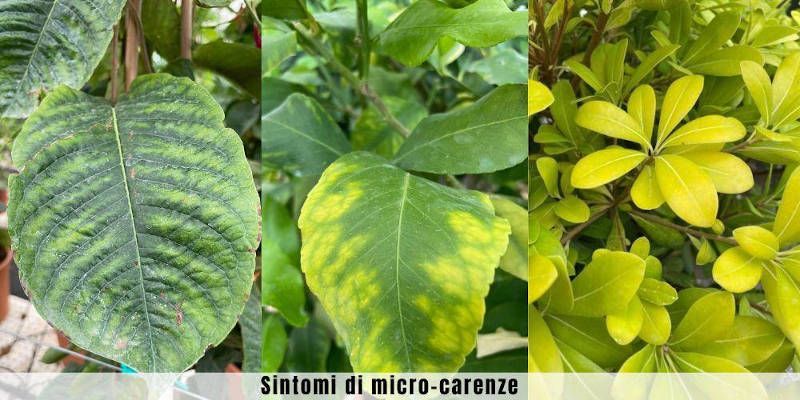
We must be able to read what the leaves communicate to us: in general, if we notice a coloration that turns from intense green to a paler green, or the internerval areas of the leaves have often necrotic (dry) patches, or, again, we notice bronze shades, relative shortening of the internodes and stunted growth of the plant or, finally, pale or dry leaf tips.
Fertilization plans
Fortunately, it is possible to intervene, as mentioned, through fertilization plans.
It is strongly recommended to fertilize by foliar application in an emergency situation with HELP BOTTOS, or Kendal Valagro Bio in this way we are able to make the element that the plant needs at that moment readily available.
Based on my experience, I recommend proceeding with ternary granular fertilizers enriched with microelements such as vigor top in a preventive and constant manner so that reserves can be created in the soil that can be used by plants during the most delicate and subsequent phenological phases of their development.
A further differentiation concerns the context in which the plants are planted: if the plant is placed in pots, specific ready-to-use soils such as Huminatural Bio could be used .
On the contrary, if our plant is in the ground, we will administer 'bottom' fertilizers such as Tiofer, (n.b. a light burial is advisable).
Remember that the organic matter in the soil influences the reserve and, therefore, the availability of microelements in the soil, therefore, good practice is to fertilize the soil in the November/December period with Prodigy Plus, which will be able to improve the chemical-physical properties of the soil.
We recommend the use of Prodigy Plus as an organic fertilizer, because in addition to the high quality of the product, of vegetable origin, it is composed of granules that are well suited for use on garden plants and turf.
Dr. Agr. Giambattista Buongiorno - Landscape agronomist.
Share this content





 Chronology
 Citrus fruits
 Turf
 Stone fruit
 Olive tree
 Ornamental
 Vegetables
 Actinidia (Kiwi)
 Screw
 Hobbies and insights
 Pome Fruit


