
Your cart
There are no more items in your cart
Monitoring and mass capture Pheromone traps
Categories :
, Chronology
Index
Monitoring andmass measurement Pheromone ratios
Introduction
The use of pheromone traps represents a valid support for the integrated defense of cultivated plants, based on the monitoring of harmful insects present in the field and on the execution of targeted treatments; This technique makes it possible to estimate the populations of phytophagous pests and to identify the right times of intervention for the execution of insecticide treatments.
Monitoring
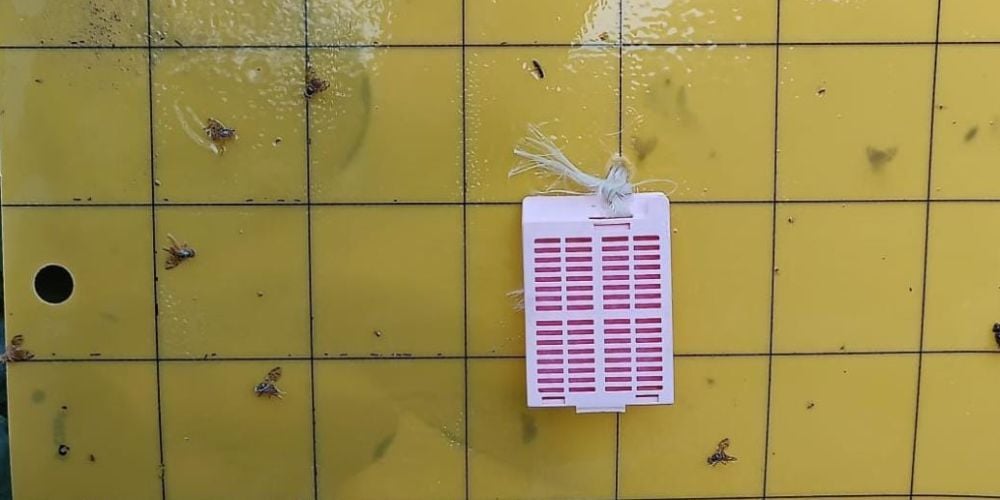
Monitoring makes use of special traps, equipped with glued supports and activated with specific substances, called pheromones; The traps can consist of simple sheets or classic "4-wind" huts, both equipped with an adhesive surface coated with glue where the insect, once landed, remains trapped.
The traps are successfully used to monitor important phytophagous plants belonging to the families of Lepidoptera (e.g. peach moth, oriental peach moth, plum moth, grapevine moth, yellow rhodiwood, cotton moth, codling moth of the apple tree), of the Rhynchoti (e.g. strong red cochineal of citrus fruits, cottony mealybug) and Diptera (e.g. fruit fly, olive fly, cherry fly).
Would you like to receive our advice? Subscribe to our Newsletter - 8% discount now for you
|
|
Pheromones
Pheromones are volatile substances, specific to each species of insect, which are emitted by mature females in order to attract males for mating; Those used in traps are nothing more than artificial pheromones chemically identical to those produced in nature that attract male individuals to the trap panel, allowing them to be captured.
By counting the number of males captured in a given period of time, it is possible to estimate and dynamically monitor the consistency of the insect population within the plots (flight curves).
The achievement of a certain number of captured individuals, which varies according to the species and crops, identifies the intervention thresholds that define the right time to carry out chemical treatments.
This concept encompasses the principles of integrated pest management which aims to bring the presence of the parasite back within acceptable limits, below the economic damage threshold; in other words, action is taken only when there is an actual need for intervention, i.e. when the population of the phytophagous reaches a critical mass such as to compromise production.
By acting in this perspective, obviously with the help of the right technical-scientific support, it is possible to reduce the number of insecticide treatments and increase the efficiency of defense programs, lowering costs for the farmer and reducing the impact of chemical treatments on human health and the environment.
The use of traps is not limited to monitoring only , but can be used for the mass capture of harmful insects.
These traps , in addition to being equipped with the specific pheromone for each species of insect to be controlled, provide for the presence of food attractants (e.g. hydrolyzed proteins, amines, ammonia salts). Unlike the previous type, these traps, thanks to the presence of food baits, allow the capture of both males and females.
Attract & kill traps
Of particular applicative interest are the traps that exploit the Attract & Kill technology .
The device consists of plastic panels or bags with a hooking system, superficially soaked in insecticide solution (pyrhetorids) and containing controlled-release attractants (e.g. trimethylamine, ammonium acetate, polyamines).
Other devices consist of simple trap-bottles containing the attractant solution or, more commonly, a concave plastic casing on which the food attractant is placed and an insecticide-treated lid on the inner face;
In all cases, insects attracted to the panel or inside the trap by attractants, come into contact with the insecticide and die.
Attract & kill traps are successfully used in orchards, citrus groves and olive groves to control flies, including the fruit fly (Ceratitis capitata), the cherry fly (Rhagoletis cerasi) and the olive fly (Dacus oleae).
Obviously, to ensure adequate control of pests and protect the crop, it is necessary to set up a large number of devices, which on average vary, depending on the case, from 50 to 100 units per hectare.
The effectiveness of these traps is subject to the extension of the surfaces: mass trapping is in fact a valid method if applied on a large scale, for example in entire districts or in large arboretums.
These devices are allowed in organic farming and have countless advantages related to the presence of specific attractants for the phytophagous and the location of the insecticide on the surface of the adhesive panel only; These include:
- absence of residue;
- absence of safety interval;
- absence of toxicological classification;
- very low environmental impact;
- harmlessness to other organisms;
- purchase without a license;
- possibility of use in organic farming and in integrated pest management programs.

Share this content



 Chronology
 Citrus fruits
 Turf
 Stone fruit
 Olive tree
 Ornamental
 Vegetables
 Actinidia (Kiwi)
 Screw
 Hobbies and insights
 Pome Fruit


