
Your cart
There are no more items in your cart
Fertilizing the olive tree: tips on how and when to fertilize
Categories :
Chronology
, Olive tree

In the field ofolive growing, an important space is occupied by the practice of fertilization. Proper fertilization of the olive tree, in fact, is essential to ensure an excellent and quality yield. In order to make this practice go well, it is necessary to keep in mind the nutritional needs of the olive grove and proceed with the nutrition operations at the correct periods. In this article, we will suggest the periods in which to proceed with fertilization and which products to use.
Index
Fertilization of an olive grove
Winter fertilization of olive tree
Fertilization of olive tree in spring
Fertilization of an olive grove in organic
***
***
Fertilizing an olive grove: guidelines
In an attempt to give you a guideline on the general rules to follow in order to proceed with proper fertilization of an olive grove, we have decided to bring back some graphs describing the nutritional needs of the olive plant. The chart we propose shows, for each element, the nutritional intake and the period when the plant needs it.
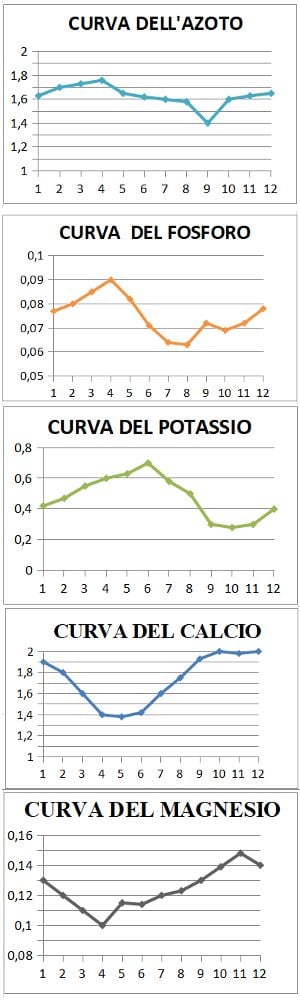
From the analysis of the graphs, we can deduce that until April the largest amount of nitrogen and phosphorus are accumulated inside the leaves, which begin to decrease from then on. Magnesium and calcium, on the other hand, were accumulated end to end of the year, and "consumed" until April. Potassium accumulates until June, after which it is "consumed."
Based on these observations, we decided to divide the various fertilizations.
***
Would you like to receive our advice? Sign up for our newsletter - 8% discount right away for you
|
***
Winter fertilization of olive tree
Plants, especially "evergreen" plants (such as olive and citrus trees are, for example), do not stop their vital functions during the winter period, so it is essential to continue feeding them. Moreover, the very winter period (November-December; January-February) is crucial for fertilizing the olive grove.
How come?
Winter fertilization of the olive tree has the premise of providing the plant with important resources, capable of creating the reserve energies for:
- a more abundant and robust flowering
- a better fruit set
- a more fruitful production of vegetation, on which the following season's flowering will occur, eliminating the "alternation" phenomenon
It is common-sense practice to distribute fertilizer localized along the row or under the canopy in order to save money by avoiding fertilizing areas unexplored by roots, and to incorporate it into the soil by tilling 10 to 15 cm deep.
Based on these considerations, our advice is to proceed with fertilizing your olive tree in the following way:
November-December: POST-CLEARING
This is the period when you need to focus on preparing the soil and improving its structure in order to have more fertile soil. Our advice falls on a particular product:
- Agribio aktiv(dosage: 1-2 kg/plant, depending on its size)
Agribio aktiv is a soil conditioner consisting of organic matter and inoculum of mycorrhizal fungi. This dual feature on the one hand improves soil structure due to its ability to make nutrients assimilable, and on the other hand limits the development of the most common root system pathogens (such as Fusarium, Pythium, Armillaria Mellea, Sclerotinia, Phytophtora, Rhizoctonia etc.), thanks to its special composition rich in trichoderma h. and rhizosphere bacteria.
However, we realize that the expenses involved may be high, especially in the case of large extensions. For this reason, Alternatively, you can use:
- Extra manure(dosage: 1-2 kg/plant, depending on its size)
It is a fertilizer containing only organic matter capable of improving soil fertility
January-February
Providing fertilizer at this time is important to ensure that during the March-April vegetative process, the olive tree finds available in the soil the nutrients it will need to process the phenological stage of pinking/blossoming.
At this stage, you can proceed with fertilization through:
- Agromaster 14.7.14(dosage: 1-2kg/plant, depending on size)
or
- Olive Grove(dosage: 1-2kg/plant, depending on size)
***
***
Fertilization of olive tree in spring
With spring just around the corner, plants are beginning to show signs of awakening, and olive trees need additional fertilization. In fact, at this specific time, fertilization will serve to provide support to improve and optimize production:
May - June
- Agromaster 10.10.16(dosage:1-2kg/plant, depending on size)
...TIPS AND TRICKS FOR FOLIAR SUPPLEMENTATION...
As an evergreen, the olive tree is a crop with intense foliar activity: in fact, the leaves are capable of intercepting the supplements provided to it through foliar fertilization. All this translates into theoptimization of interventions, as we will be able to make the right intervention according to the phenological phase with an important economic saving.
Our advice, therefore, is to intervene in the vegetative recovery phase by supplying the plant with amino acids, nitrogen, potassium and microelements useful for developing a more luxuriant flowering, which will translate, as we know, into good production.
- Fury(dosage: 400g/hl)
- Phylen(dosage: 500g/hl)
- Welgro Complex (dosage: 200g/hl)
At the pre-bloom/blossom stage, we will proceed by supplying the plant with strategic elements for this stage, such as boron and molybdenum:
- Organor N 12(dosage: 250g/hl)
- Molibor Extra(dosage: 150g/hl)
During flowering, we will supply the plants with natural biostimulants and microelements, through:
- Glibor Ca(dosage: 250ml/hl)
- Organor N12(dosage: 250g/hl)
In the fruit growth phase, when the plant now has fruitlets, our advice is to give it a promoter based on algae extract with the addition of potassium, calcium and other microelements:
- Mc Cream(dosage: 200ml/hl)
- Loess Ca(dosage: 200g/hl)
- Welgro complex(dosage: 200g/hl)
Summer months of July-August
- Tionamm(dosage: 1-2kg/, depending on the size of the plant)
***
***
Fertilization of the olive grove in organic farming
With the agronomic tools available today, organic crops manage to provide high yields while requiring a few more operations. Organic fertilization of an olive grove, in fact, involves the administration of the elements proposed in the nutritional tables in the first paragraph, substituting for only organic fertilization in the winter months (November-December) a type of fertilization carried out with fertilizers allowed in organic agriculture, called organo-mineral.
In recent years, organo-mineral fertilizer has been gaining popularity even in conventional agriculture because of its dual composition: organic + mineral. This particular type of structure ensures good soil fertility such that the mineral elements are readily available to the roots.
The only caution to have when using organo-mineral fertilizers is to proceed with a light burial, which is useful to avoid evaporation of the elements and make them available within the soil.
In addition, organo-mineral is a fertilizer that performs its function more gradually over time. For this reason, our advice is not to delay in fertilizing and to carry it out within the following time frame.
The nutritional program of an olive grove under organic regime includes:
November-December
- Orga-kem 10.5-5(dosage: 2/3kg plant depending on size)
- Orgakem 6.11.8(dosage: 1- 1.5kg/plant)
May-June
- Polysulphate(dosage: 1- 1.5 kg/plant)
...FOLIAR TREATMENTS ALLOWED IN ORGANIC...
even under organic farming, our advice is to intervene through foliar supplements in order to more rapidly provide strategic elements to improve the organoleptic properties of the productions.
Vegetative recovery phase:
- Fury(dosage: 400g/hl)
- HAIFA Micro Comb(dosage: 100g/hl)
In the pre-bloom/blossom stage, we will proceed by supplying the plant with strategic elements for this stage, such as boron and molybdenum:
- Gold Dust(dosage: 500g/hl)
- Molibor Extra(dosage: 150g/hl)
During flowering, we will bring natural biostimulants and microelements to the plants through:
- Glibor Ca(dosage: 250ml/hl)
- Organor N12(dosage: 250g/hl)
In the fruit growth phase, when the plant now has fruitlets, our advice is to provide it with a promoter based on algae extract with the addition of potassium, and other microelements:
- Mc Cream(dosage: 200ml/hl)
- Ener 26(dosage: 250g/hl)
- HAIFA Micro Comb(dosage: 100g/hl)
Share this content


 Chronology
 Citrus fruits
 Turf
 Stone fruit
 Olive tree
 Ornamental
 Vegetables
 Actinidia (Kiwi)
 Screw
 Hobbies and insights
 Pome Fruit


By Giorgio Cento 2018-02-27 19:08:55
Ho già concimato, gennaio 2017 con Multicomp Sart 25-7-12, e vi assicuro con buoni esiti. Quest'anno proponete un nuovo prodotto Polysulphate che dovrebbe apportare una buona riserva di potassio e magnesio. Quest'anno darò 2 parti di Multicomp e una parte di Poysulphate. Confido in un ottimo risultato. Voi consigliate come epoca di concimazione gennaio, ma credo di avere comunque buoni risultati concimando ora a fine febbraio. Giorgio Cento