
Your cart
There are no more items in your cart
Fruit fly Ceratitis Capitata Bio remedies
Categories :
Actinidia (Kiwi)
, Chronology
, Citrus fruits
, Pome Fruit
, Screw
, Stone fruit
Index
Organic Strategy for the fight against the fruit fly
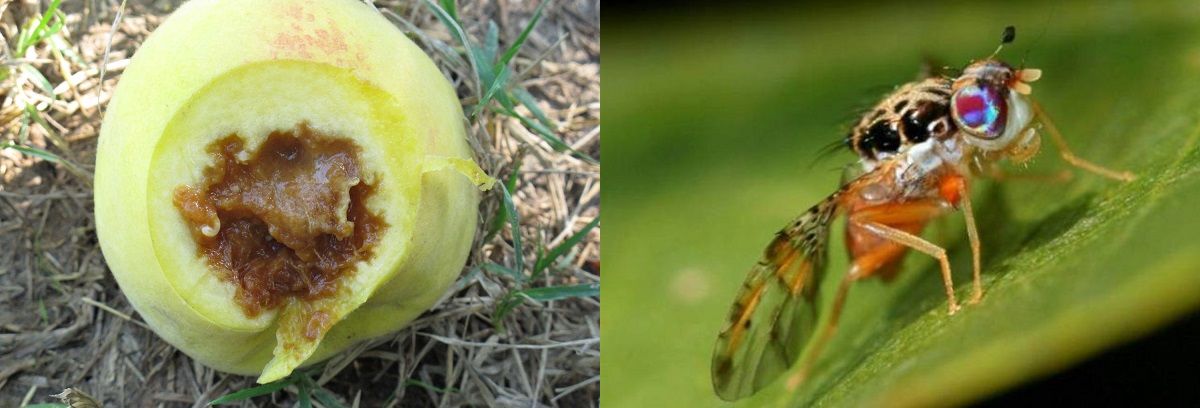
Fruit fly remedies Bio - Ceratitis Capitata
The fruit fly is a real plague for over 250 crops of agronomic interest. Almost any plant that produces sweet and tender fruits can be attacked by this fearsome pest. Whether it is the peach tree in front of the house, or the plants of a large intensive farm, no fruit is safe. From the eggs laid inside the fruits come out the larvae of the fruit fly, which as soon as they are born are just a millimeter long, difficult to see even with the naked eye. They grow by feeding on the pulp of the fruits, and reach a length of 7-9mm. They dig tunnels that cause localized rot in the pulp and significant depreciation of the affected fruits.
In some cases, attacks affect up to 100% of production. The danger of damage from the Mediterranean fruit fly (Ceratitis capitata) is increased by oviposition stings which, by only accelerating the ripening of the epicarp, can cause the early fall of the fruits
***
***
Would you like to receive our advice? Subscribe to our Newsletter - 8% discount now for you
|
1. How to fight the fruit fly?
Until recently, the only effective method of fighting the Mediterranean fruit fly involved the use of chemical treatments. However, to date we have mass capture traps: biological, safe and effective tools that will allow us to reduce the fly population to minimum levels, thus preventing the threshold of harmfulness from being exceeded.
2. Organic Strategy for the fight against the fruit fly
When the fruits change color, they begin to accumulate sugar inside them and the skin becomes less resistant (veraison phase), it is the moment in which they become more susceptible to the attack of the fruit fly.
Before the veraison phase, therefore, it becomes of fundamental importance to keep the population under control through monitoring traps, because the more the fruit goes on in its growth phase, the more sensitive it will become to the attack of this diptera.
When to put and how to place monitoring traps for the fruit fly?
Before veraison, our advice is to place:
- Temo O Cid
with its
Take care to place 2 to 4 traps per hectare depending on the shape of the surface, exposing the traps to the prevailing winds. In this way, you will be able to position the next intervention in the best possible way.
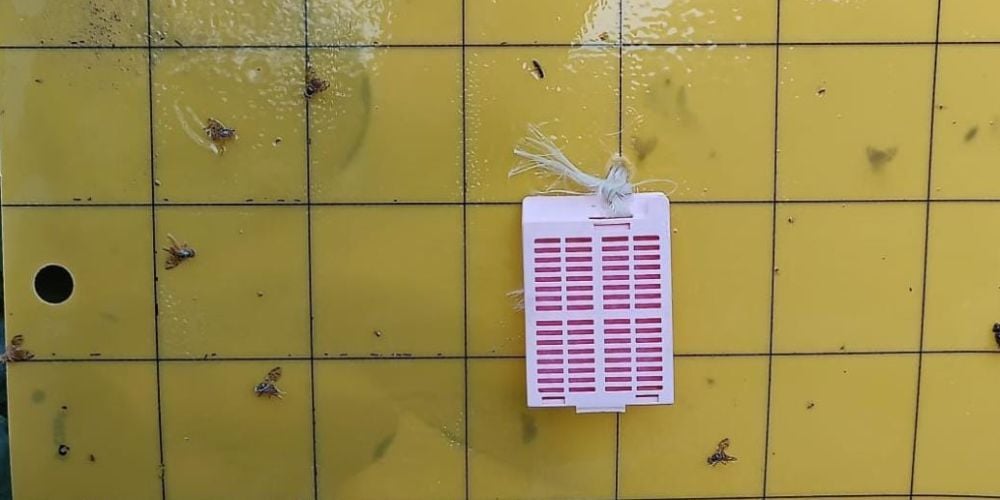
In conjunction with the positioning of the monitoring traps (before veraison), also provide for the placement of the traps for mass capture within the field. You can also move well in advance, given the good durability of these products.
Once placed according to the label, the traps ( so-called Attrack & Kill) will take care of keeping the population level of Ceratitis Capitata low. Here are some of the traps we recommend:
- Decis Trap (65 traps per hectare)
It is important that this trap is placed 40-50 days before the veraison of the fruit or 50 days before harvesting. The device should be hung securely from the end of the tree branch (preferably on the side exposed to the sun), at a height of 1.40 - 1.80 m from the ground. For optimal results, we suggest that you arrange the traps in a quincunx pattern.
- Biomagnet (50-75 traps per hectare)
Our advice is to distribute this trap, taking care to select the branches of medium vigor and place them at a height of 150-200 cm. If you find yourself with a greater number of traps, then you will not make a mistake if you use the excess quantities to reinforce the areas of greatest susceptibility. Finally, remember to remove the traps at the end of each season.
- Ceratipack (50-80 traps per hectare, depending on the severity of the attack)
Ceratipack should be hung on the end of the branch, taking care to choose a branch that is not subject to summer pruning. The recommended height is 1.40-1.80 meters. To ensure optimal results, it is advisable to distribute the traps evenly throughout the orchard, following a quincunx pattern. In view of a more accurate control, we suggest placing the trap in the parts of the crown where there are no fruits.
A possible subsequent intervention cannot be ruled out a priori: there are years, in fact, in which the insect is particularly invasive. In these cases, the mass trapping trap will also act as a monitor. Therefore, at the peak of capture it will not be wrong to place a complementary intervention to avoid damage to your fruits with:
- Spintor Fly (dosage: 1-1.2 L/ha diluted in 4 L/ha of water)
Once diluted in water, it is important that Spintor Fly is used within 12 hours of preparation of the mixture. For the correct use of this product, it is of paramount importance to use single jet or adjustable nozzles. Treatments should be performed at intervals of 7-10 days, using the shortest intervals when the fruit is ripening or when the level of Ceratitis capitata populations is quite high. Longer intervals, on the other hand, can be used when the number of flies caught by the traps is low. We suggest that you repeat the treatment in case of rain, as the bait is washed away.
For those who do not want to use mass capture traps, while remaining in the field of biological control, then you can proceed with positioning the monitoring trap:
- Temo O Cid with respective pheromones
At peak flights , we suggest you intervene with:
- Spintor Fly (dosage: 1-1.2 L/ha diluted in 4 L/ha of water)
3. Conventional strategy
After placing Temo O Cid and their respective pheromones, place Trebon Up at the peak of flight, at a dosage of 600-750ml/ha.
Share this content


 Chronology
 Citrus fruits
 Turf
 Stone fruit
 Olive tree
 Ornamental
 Vegetables
 Actinidia (Kiwi)
 Screw
 Hobbies and insights
 Pome Fruit


