
Your cart
There are no more items in your cart
How is grapevine downy mildew combated? (Plasmopara Viticola)
Categories :
Chronology
, Screw
Index
Plasmopara viticola: life cycle
How do you recognize grapevine downy mildew?
How is grapevine downy mildew combated?
***
***
Grapevine downy mildew is a particular pathogen (Plasmopara viticola) that arrived in Italy due to vines imported from America. It is a vine disease particularly widespread in Northern Italy and less so in the South, where the scarce presence of rainfall does not favor the appearance of the pathogenic fungus.
Downy mildew attacks cause considerable damage to both the quantity and quality of vineyard production. Let's find out together how to recognize the disease and what are the strategies to combat it
***
***
Plasmopara viticola: life cycle
During the vegetative rest of the vine, Plasmopara viticola is able to guarantee its survival thanks to the oospores that have formed in the infected tissues during sexual reproduction. Oospores are not able to germinate immediately, but need a period of maturation thanks to which they develop a particular type of structure thanks to which they keep their vitality intact.
After the ripening period, the germination capacity of the oospores increases. Thus, thanks to a sufficiently humid soil and particular climatic temperatures (10°C), the formation of macrosporangia is favored and, at the first useful rains, their transfer to the receptive organs of the vine will be facilitated. In this way, the primary infection begins.
The primary infection begins in spring when what is called the rule of 3 tens is reached:
- average temperature around 10°C
- average length of young shoots of at least 10 cm
- rainfall of at least 10 mm on the first/second previous day
The incubation period of the disease, i.e. the time that passes from the primary infection phase to the appearance of the first symptoms, depends on some factors such as:
- temperature
- humidity
- type of tissue actually affected by the pathogen
Once the incubation period is over, the first symptoms of infection appear and the pathogenic fungus escapes in the form of efflorescence similar to a white mold, consisting of sporangiophorous and sporangia branches.
Under favorable conditions, the sporangia germinate, releasing zoospores. In this way, secondary infections are initiated.
***
Would you like to receive our advice? Subscribe to our Newsletter - 8% discount now for you
|
***
How do you recognize grapevine downy mildew?
The symptoms of this vine disease can be identified on the leaves and bunches of grapes. Let's proceed with the description.
Symptoms on the leaves
.jpg)
The oil spot, on young leaves and in case of early infection, is characterized by round patches on the upper page of the leaf. In the event of early infection, the oil stain will necrotize starting from the center with subsequent desiccation that can lead to partial defoliation of the plant. In the presence of high humidity, a whitish mold may appear around these stains.
Over time, the leaf tissue thickens, thus becoming more resistant to attacks by downy mildew. The veins of the leaves, therefore, will be able to create barriers to vine disease. Therefore, on old leaves and for late attacks, small necrotic spots (so-called mosaic) will be noticed between the veins of the leaves.
Symptoms on the bunches: Larvate downy mildew
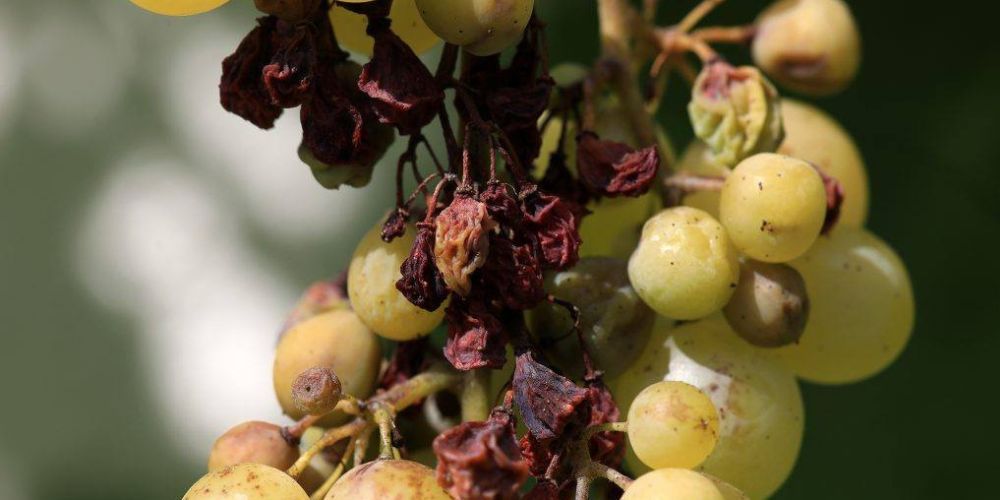
After fruit set, grapevine downy mildew manifests itself on the berries, which will appear dark and will be characterized by the absence of mycelium (so-called larvate downy mildew). The smaller berries will tend to become covered with mold and the rachis will take on the typical "S" curvature.
On the vineyards in production, the greatest damage of this specific vine disease is found in the flowering-fruit set phase, where infections in the bunches negatively affect production.
Downy mildew: the damage
Plasmopara viticola uses the natural openings of the host plant, thus managing to colonize all the green organs of the vine on which there are functioning stomata. Thus, by being able to affect the active organs , the most serious infections can even compromise the general metabolism of the plant, reducing its ability to produce sugars and negatively affecting the quality of the final product.
In general, the damage from downy mildew of the vine can be:
- direct products, i.e. those relating to bunches and causing production losses
- indirect and concerning damage related to the vegetative organs of the vine
However, downy mildew damage is closely linked to the phenological phase and the time when infection occurs.
***
***
How is grapevine downy mildew combated?
Our strategy to combat downy mildew in the vine involves a series of interventions starting from the phase of stretched leaves, up to that of veraison.
with outstretched leaves
In this phase, we will proceed with a mixture consisting of:
- Shelter (dosage: 330g/ha)
- Cobre Nordox (dosage: 1.5kg/ha)
Thanks to its citrotopic function, the Shelter will block the infection in progress from the inside. The copper contained within Cobre Nordox, on the other hand, will serve to ensure double protection from downy mildew
in visible clusters and in the process of separate buttons
- Ridomil Gold R (dosage: 4l/ha)
Ridomil Gold R, based on Metalaxyl-l and with low copper content, guarantees a preventive and curative action against downy mildew
Fruit set phase
- Cobre Nordox (dosage: 1.5kg/ha)
pre-closing and veraison phase
- R6 Bordeaux (dosage: 4kg/ha)
R6 Bordeaux is a systemic fungicide based on Fosetyl-aluminium and Copper, which guarantee an important protective action against downy mildew
Bunch closure and veraison phase
- Cobre Nordox (dosage: 1.5kg/ha)
- Shelter (dosage: 330g/ha)
Share this content




 Chronology
 Citrus fruits
 Turf
 Stone fruit
 Olive tree
 Ornamental
 Vegetables
 Actinidia (Kiwi)
 Screw
 Hobbies and insights
 Pome Fruit


