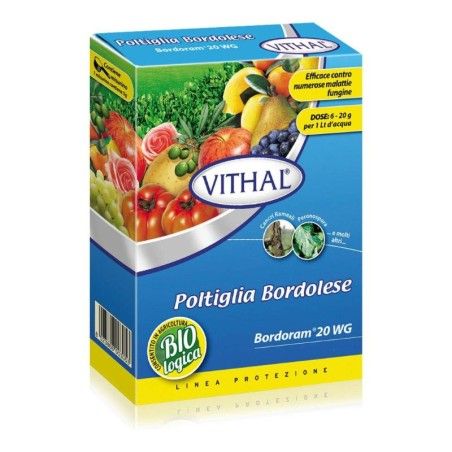
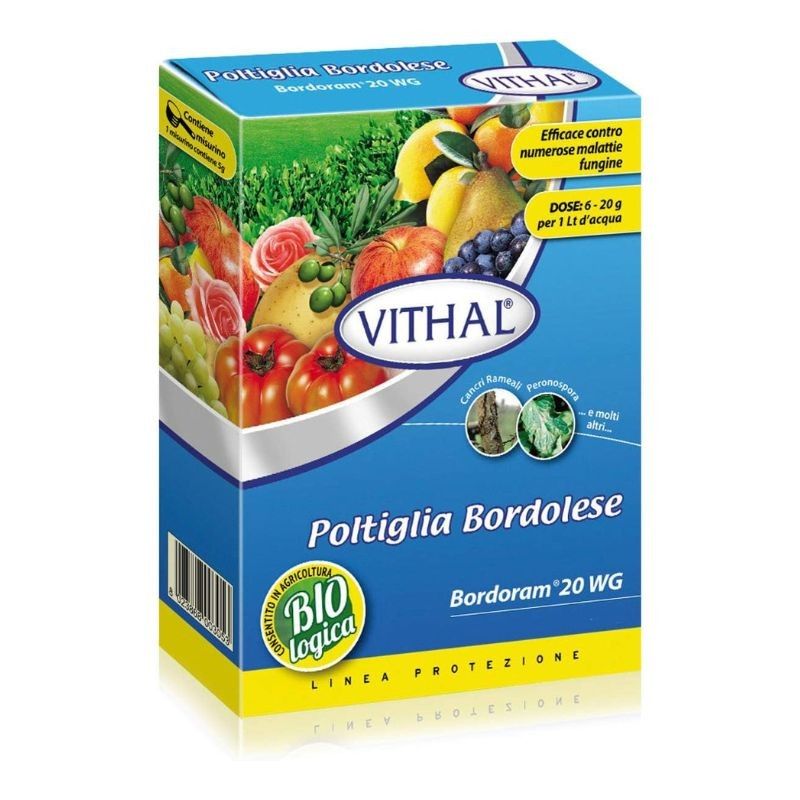
Bordeaux mixture Bordoram 20 WG ( PFnPE) copper contact fungicide with preventive action
Bordolese pulp Bordoram 20 WG is a copper-based fungicide used mainly in organic and conventional agriculture for the prevention and control of many fungal diseases. It is a mixture of copper sulfate neutralized with hydrated lime that produces a stable suspension when diluted in water, forming a protective barrier on the surface of plants. Bordoram 20 WG Bordeaux mixture is an effective product used for the prevention and control of many fungal diseases in agriculture. Do not use the product during flowering. If it rains after treatment, the treatment should be repeated. If you have a license, you can purchase by clicking this button the10 kg bag of bordolese pulp
Composition Bordeaux mixture Bordoram 20 WG :
doses and methods of use of Bordolese pulp Bordoram 20 WG:
- Dose per liter of water: 6 - 20 g
- VINES: against Downy mildew, Anthracnose, Bacteriosis: intervene at a dose of 375 - 1250 g/hl of water (3.75 - 5 kg/ha), using 400 to 1000 /ha of water; make 4 - 6 applications per season, starting when the vegetation has a development of about 10 cm when the climatic conditions favorable to the adversity occur and with a minimum interval between treatments of 7 days.
- POME FR UIT (apple, pear, quince, loquat): against scab, copper cancers, rot and bactereiosis: intervene at a dose of 375 to 1000 g/hl water (3.75 to 5 kg/ha), using 500 to 1000 I/ha water; make 2 to 4 applications per season, either in autumn treatments (after harvest) or at vegetative regrowth up to the pre-flowering stage when conditions favorable to the adversity occur, with a minimum interval between treatments of 7 days.
- DRUPACES (peach, apricot, plum, cherry, nectarine): against Blotch, Corineus, Rot, Cherry Cylindrosporiosis, Copper Drying, Bacteriosis and Pox: intervene at a dose of 375 to 1250 g/hl dacqua (3.75 to 5 kg/ha), using 400 to 1000 l/ha of water; make 2 to 4 applications per season in both autumn treatments (from 50% leaf fall) and at vegetative restart up to the pre-flowering stage when conditions favorable to the pests occur, with a minimum interval between treatments of 7 days.
- ALMOND against Blotch, Corineus, Rot, Bacteriosis, Pox, and FRUITFULS WITH SHEAD FRUIT (walnut, hazelnut, chestnut, pistachio) against Alternaria, Bacteriosis, Hazelnut detachment disease, Chestnut Fersa: intervene at a dose of 375 to 1000 g/hl of water (3.75 to 5 kg/ha), using 500 to 1000 I/ha of water; make 2 to 4 applications per season in both autumn treatments ( from 50% leaf drop) and at vegetative restart up to the pre-flowering stage when conditions favorable to the adversity occur, with a minimum interval between treatments of 7 days.
- OLIVE: against Peacock's Eye, Leprosy, Bacteriosis. intervene at a dose of 375 to 835 g/hl of water (3.75 to 5 kg/ha), using 600 to 1000 !/ha of water; make 2 to 6 applications per season beginning at vegetative regrowth and up to veraison upon the occurrence of conditions favorable to the adversity, with a minimum interval between treatments of 7 days.
- AGRUMES (orange, lemon, tangerine, grapefruit): against Gummosis, Brown spot, Bacterial piticchia: intervene at a dose of 185 to 500 g/hl of water (3.75 to 5 kg/ha), using 1000 to 2000 l/ha of water; make 3 to 5 applications per season starting at vegetative recovery and continuing until two weeks before harvest when conditions favorable to the adversity occur, with a minimum interval between treatments of 7 days.
- SOLANACES (tomato, eggplant)in field and greenhouse; INFLORESCENT CABBAGE (cauliflower, broccoli) in field; COMMESTIBLE BUCCAGE (cucumber, gherkin, zucchini) in field and greenhouse; NON COMMESTIBLE BUCCAGE (melon, watermelon, squash) in field against Downy mildew, Alternariosis, Anthracnose and Bacteriosis: intervene at a dose of 375 to 1250 g/hI of water (3.75 to 5 kg/ha). using from- 400 to 1000 l/ha of water ; make from : 3 to 5 applications from the early stages of development and up to pre-harvest when conditions favorable to the pests occur, with a minimum interval between treatments of 7 days.
- BULK VEGETABLES (onion, garlic, shallot) in the field; LETTUCE AND OTHER SALADS in the field and greenhouse; SPINACH AND SIMILAR in the field and greenhouse against Downy mildew, Rust, Anthracnose, Alternaria, Bacteriosis and Sclerotinia: intervene at a dose of 375 to 1250 g/hI of water (3.75 to 5 kg/ha), using 400 to 1000 I/ha of water; make 3 to 6 applications from the early stages of development to pre-harvest when conditions favorable to the disease are encountered, with a minimum interval between treatments of 7 days.
- FRESH LEGUMES (green bean, pea, mangetout pea, lentil) in the field: against Anthracnose, Downy mildew, Septoria, Bacteriosis and Rust: intervene at a dose of 375 to 1250 g/hl of water (3.75 to 5 kg/ha), using 400 to 1000 I/ha of water, make 3 to 6 applications starting from early developmental stages and up to pre-harvest when conditions favorable to the pests occur, with a minimum interval between treatments of 7 days.
- POTATO in the field against Downy mildew, Alternariosis, Anthracnose and Bacteriosis: intervene at a dose of 375 to 1250 g/hl of water (3.75 to 5 kg/ha), using 400 to 1000 l/ha of water; make 3 to 6 applications from the early stages dis development and up to pre-harvest at the occurrence of conditions favorable to the adversity, with a minimum interval between treatments of 7 days.
- ORNAMENTAL FLORALS : in the field against Downy mildew and Rot: intervene at a dose of 375 to 1250 g/hl water (3.75 to 5 kg/ha) and make 2 to 3 applications during the growing season at the occurrence of conditions favorable to the adversity, with a minimum treatment interval of 7 days.

 Allowed in