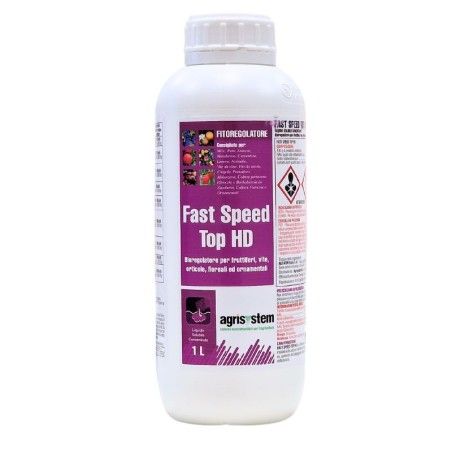
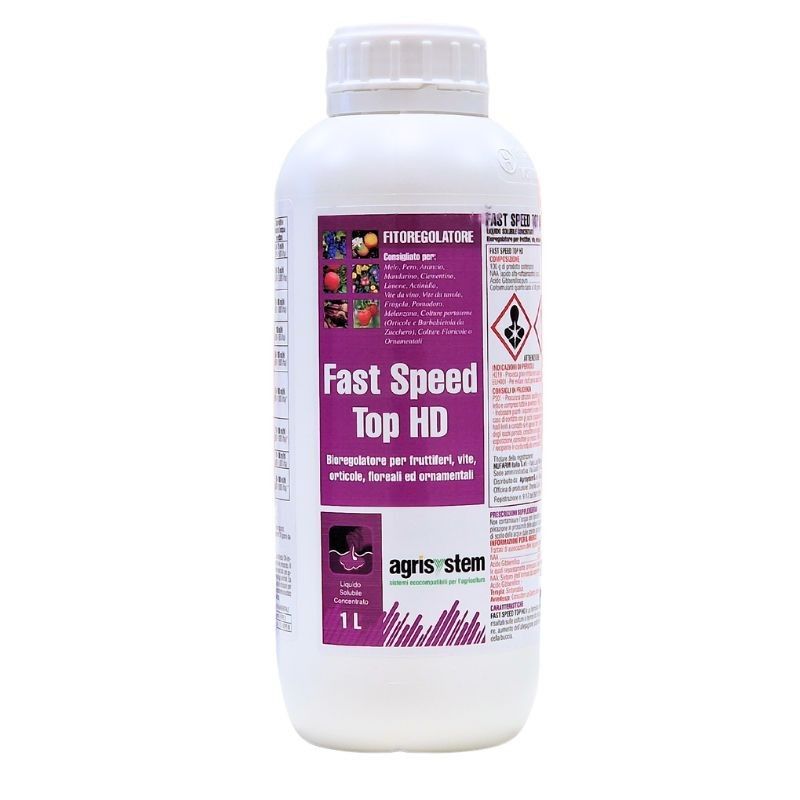
Fast Speed Top HD is a bioregulator with a stimulating action on vegetative development, early flowering and maturation
Fast Speed Top HD is a phytohormone-based formulation developed to obtain the best results on crops in terms of:
- vegetative development,
- early flowering and ripening,
- increase in fruit set,
- uniformity of fruit size
- better pigmentation of the skin.
Agrisystem Fast Speed Top consists of:
- NAA (alpha-naphthalenacetic acid) pure 0.89% (1.65 g/L)
- Pure Gibberellic Acid 0.45% (5.4 g/L)
- Co-formulants as needed per g 100
Doses and methods of use:
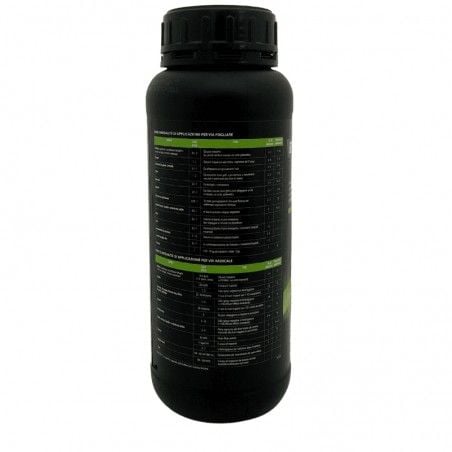
Fast Speed Top HD can be applied on its own, both in foliar applications and in those with hose distribution. The product, being a bioregulator, is? influenced in its action by environmental factors (temperature, humidity?) and the state of the crop (nutritional, health), it is therefore advisable to intervene on plants in good physiological condition.
- However, to improve fruit set, carry out a single treatment in the early stages of petal fall at the following doses: 0.75 l/ha or 50 - 75 ml/hl.
- Orange, mandarin, clementine and lemon to promote fruit set and to improve the size and quality of the fruit: use 1 - 1.5 l/ha or 50 - 75 ml/hl. A first treatment at the beginning of flowering repeated at the beginning of petal fall. For fruit enlargement, treat after fruit set at the beginning of veraison. Make a maximum of 2 applications per year.
- Actinidia, for the thinning of secondary flowers and to improve the size and shape of the fruits: use 0.75 - 1 l/ha or 75 - 100 ml/hl. 1st intervention with barely visible secondary floral sketches. 2nd petal fall surgery. 3rd surgery after 7-10 days.
- Wine vine, for the elongation of the bunch, for the thinning of the berries, to obtain a more sparse bunch and to improve the quality of the grapes, use 0.75 l/ha or 100 ml/hl. Intervene with a bunch visible 3-5 cm.
- Table Screw:
- For berry enlargement (seedless varieties e.g. thomson, crimson): 1st berry intervention 3-4 mm, to be repeated after 10-15 days, at a dose of 1 l/ha or 50 - 100 ml/hl.
- Seeded varieties (e.g. Italy, Vittoria): 1st 3-4 mm berry intervention, to be repeated after 10-15 days, at a dose of 0.5 l/ha.
- To promote rooting, make 2 fertigation applications. The first intervention in post-transplantation, the second in pre-flowering, at a dose of 0.75 - 1 l/ha or 75 - 100 ml/hl.
- To anticipate flowering and harvesting, make 2 foliar applications or mixed with the irrigation water in a hose. The first intervention 1 week before flowering to be repeated after petal fall/attachment, at a dose of 0.75 - 1 l/ha or 75 - 100 ml/hl. Carry out a maximum of 2 applications per crop cycle.
- Tomato and aubergine to improve flowering, fruit fruit setting and size: carry out 2-3 applications mixed with irrigation water in a hose. The first intervention is 1 week before flowering to be repeated during flowering and fruit enlargement, at a dose of 0.75 - 1 l/ha or 75 - 100 ml/hl. In the case of foliar treatments, make a single application. Use of the product allowed only in greenhouses.
- Seed-bearing crops (horticultural and sugar beet): to improve seed climbing, 1-2 applications are recommended starting just before seed starting, to be repeated after 7 days, at a dose of 0.75 - 1 l/ha or 75 - 100 ml/hl.
- Flower or ornamental crops grown in greenhouses, in the open field and in nurseries: to increase rooting, flowering, flower size and foliar/woody biomass, repeated foliar or hose applications are recommended, at intervals of 15-20 days, at a dose of 0.5 - 1 l/ha or 50 - 100 ml/hl.