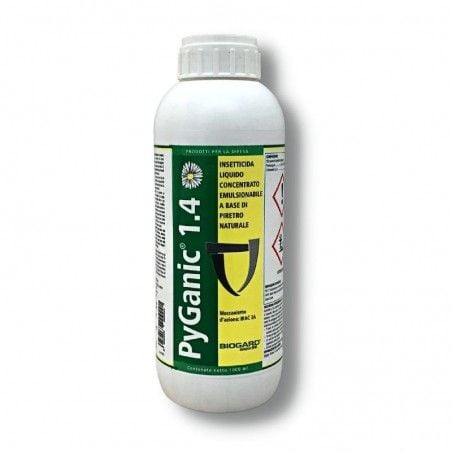
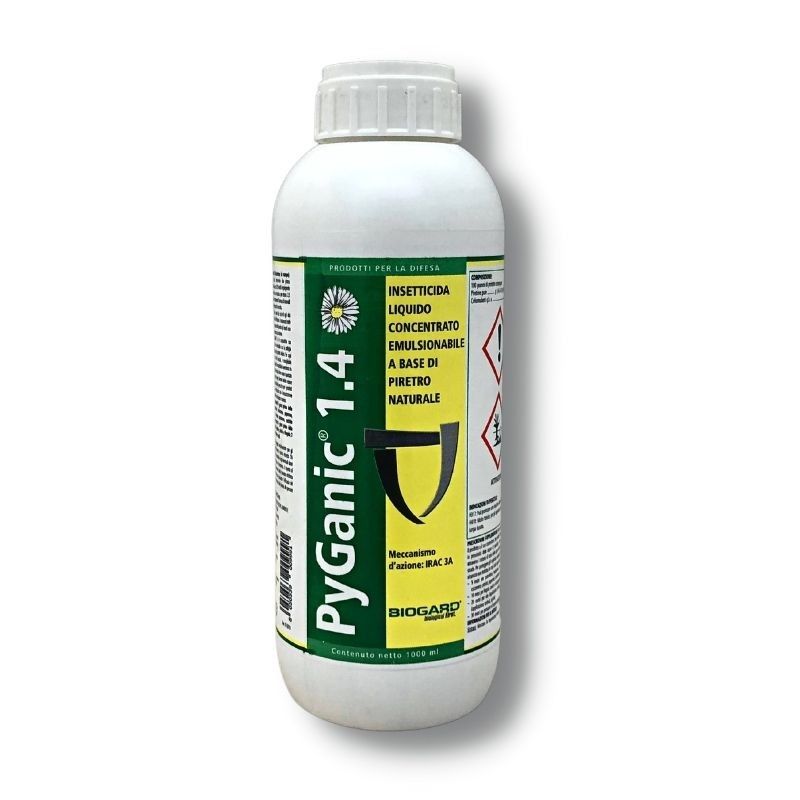
Pyganic 1.4 is a natural insecticide that acts quickly by contact on all pests of vegetables, fruit and flowers.
- Convenient concentrated liquid emulsion
- Based on natural pyrethrum extracted from Tanacetum Cinerariefolium
- Effective against aphids, whitefly whiteflies, leafhoppers and psyllae
- IRAC 3A Mechanism of Action
Composition per 100 grams:
- Pure pyrethrins g 1.4 (=12.9 g/l) (purity 480 g/kg)
- Co-formulants to taste at 100 g
Use and Doses:
Use sufficient volumes of water to ensure complete and uniform wetting of the vegetation, paying particular attention to the treatment of the underside of the leaves in the case of whitefly whiteflies.
Intervene at the first appearance of parasites, possibly in the evening and in any case in the coolest hours of the day.
The product is recommended in integrated and biological pest management programs and in alternating use with other products for resistance management
Plum, apricot, peach and nectarine against Aphids (Myzus persicae, Hyalopterus amygdale, Hyalopterus pruni): intervene at the first appearance of the parasites at a dose of 150-250 ml/hl using 300-1000 L of water/ha (maximum dose per hectare 2.5 litres); Carry out a maximum of 2 treatments per year, at intervals of 3-20 days from the "pink buttons" phase up to 7 days before harvesting.
Cherry against Aphids (Myzus cerasi): intervene at the first appearance of parasites at a dose of 150-250 ml/hl using 300-1000 L of water/ha (maximum dose per hectare 2.5 litres); Carry out a maximum of 3 treatments a year, at intervals of 3-4 days, from the end of petal fall phase up to 7 days before harvesting.
Pome fruit (apple, pear, quince, medlar) - against Aphids (Aphis pomi, Dysaphis plantaginea): intervene at the first appearance of parasites at a dose of 150-250 ml/hl using 300-1000 L of water/ha (maximum dose per hectare 2.5 liters); - against Psylla: intervene at the first appearance of parasites at a dose of 250 ml/hl using 300-1000 L of water/ha (maximum dose per hectare 2.5 litres); - against the Asian stink bug (Halyomorpha halys): intervene at the first appearance of the parasites at a dose of 250 ml/hl using 300-1000 L of water/ha (maximum dose per hectare 2.5 litres). Carry out a maximum of 2 treatments per year, at intervals of 3-20 days, from the "pink buttons" phase up to 7 days before harvesting.
Citrus fruits (grapefruit, lemon, orange, lime, tangerine, clementine, tangerine, mineola and other hybrids): against Aphids (Aphis citricola): intervene at the first appearance of parasites at a dose of 150 ml/hl using 500-1500 L of water/ha (maximum dose per hectare 2.25 liters); carry out a maximum of 2 treatments per year, at intervals of 4-6 days, between the "green button" phase and the fruit phase with a size of about 50% of the final size.
Grapevine against leafhoppers (Scaphoideus titanus, Empoasca vitis), Asian stink bug (Halyomorpha halys) and Fruit fly (Drosophila suzukii): intervene at the first appearance of parasites at a dose of 300 ml/hl using 200-1000 L of water/ha (maximum dose per hectare 3 liters); Carry out a maximum of 2 treatments a year, at intervals of 6 days, between the closure of the bunch and the end of veraison.
Tomato, eggplant, pumpkin, zucchini, melon, watermelon, cucumber (in the field and in greenhouses) against Aphids (Myzus persicae, Aphis gossypii): intervene at the first appearance of parasites at a dose of 250 ml/hl using 300-1000 L of water/ha (maximum dose per hectare 2.5 liters); Carry out a maximum of 2 treatments per year, at intervals of 3-7 days, from pre-flowering until 3 days before harvest.
Tomato, eggplant, pumpkin, zucchini, melon, watermelon, cucumber (in greenhouses) against Whitefly (Trialeurodes vaporariorum, Bemisia tabaci): intervene at the first appearance of parasites at a dose of 250 ml/hl using 300-1000 L of water/ha (maximum dose per hectare 2.5 liters); Carry out a maximum of 2 treatments per year, at intervals of 3-7 days, from pre-flowering until 3 days before harvest.
Pepper (in the field and in greenhouses) against Aphids (Myzus persicae, Aphis gossypii): intervene at the first appearance of parasites at a dose of 150-250 ml/hl using 300-1000 L of water/ha (maximum dose per hectare 2.5 liters); Carry out a maximum of 3 treatments per year, at intervals of 3-7 days, from pre-flowering until 3 days before harvesting.
Pepper (in greenhouses) against Whitefly (Trialeurodes vaporariorum, Bemisia tabaci): intervene at the first appearance of the parasites at a dose of 150-250 ml/hl using 300-1000 L of water/ha (maximum dose per hectare 2.5 liters); Carry out a maximum of 3 treatments per year, at intervals of 3-7 days, from pre-flowering until 3 days before harvesting.
Bean, green bean, pea (in the field and in greenhouses) against Aphids (Aphis fabae, Acyrthosiphon pisum): intervene at the first appearance of parasites at a dose of 150-250 ml/hl using 100-1000 L of water/ha (maximum dose per hectare 2.5 liters); Carry out a maximum of 2 treatments a year, at intervals of 3-7 days, from pre-flowering to 4 days before harvesting.
Inflorescence cabbage (Broccoli cabbage, Cauliflower in the field) against Aphids (Brevicoryne brassicae) and Whitefly (Aleyrodes proletella): intervene at the first appearance of parasites at a dose of 150-250 ml/hl using 100-1000 L of water/ha (maximum dose per hectare 2.5 liters); Carry out a maximum of 3 treatments per year, at intervals of 3-7 days, between the phase of the 5th true leaf opened and the phase of fruits with a size of about 50% of the final size. Strawberry (in the field and in greenhouses) against Aphids (Chaetosiphon fragaefolii, Aphis gossypii): intervene at the first appearance of the parasites at a dose of 150-250 ml/hl using 400-1000 L of water/ha (maximum dose per hectare 2.5 liters); Carry out a maximum of 2 treatments a year, at intervals of 3-4 days, from the phase of the first open flowers until 4 days before harvesting.
Floral and ornamental (Chrysanthemum in the field) against Aphids (Aphis fabae): intervene at the first appearance of parasites at a dose of 250 ml/hl using 100-1000 L of water/ha (maximum dose per hectare 2.5 liters); Carry out a maximum of 2 treatments per year, at intervals of 3-7 days, from pre-flowering to harvest.

 Allowed in