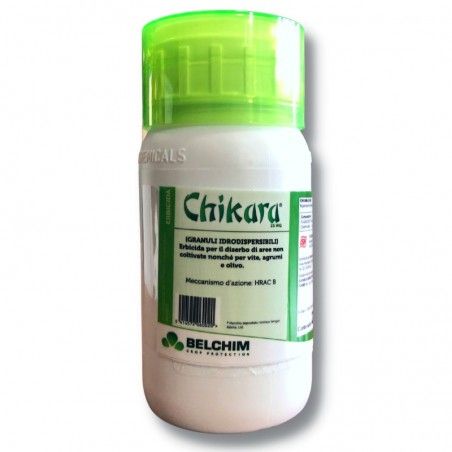
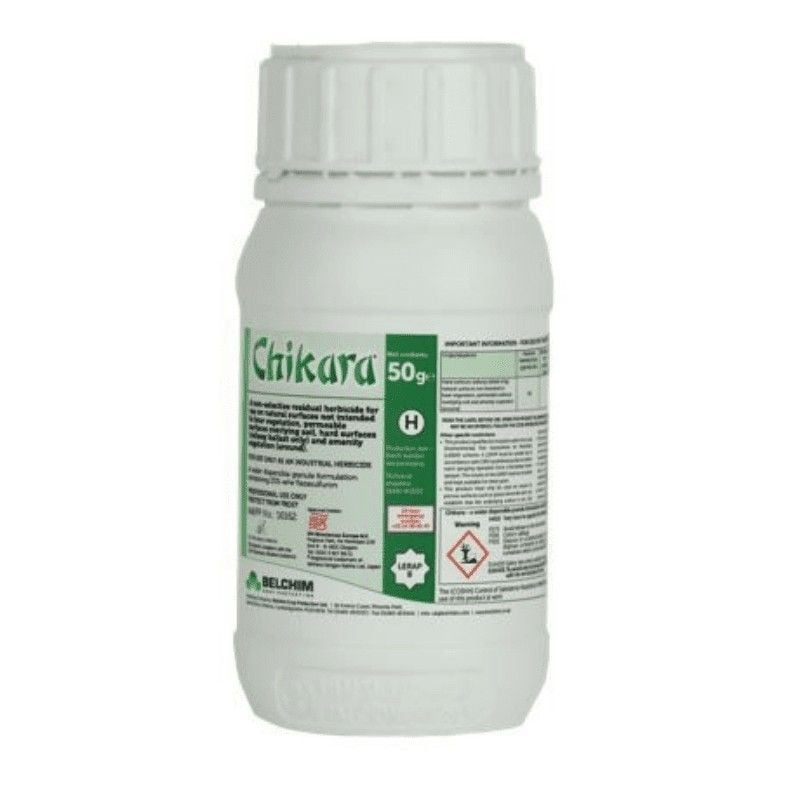
Chikara 25 WG Belchim for residual weeding of vines, olives and citrus fruits
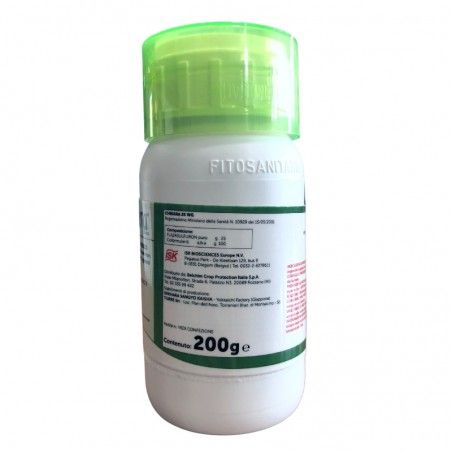
Composition:
- Pure FLAZASULFURON 25 g.
- Co-formulants q.b.a. 100 g
Available packages: 50g - 200 g
Hazard statements: N - hazardous to the environment
This selective herbicide is applied in pre-emergence or early post-emergence of weeds mixed with glyphosate-based preparations.
Citrus fruits: 60-80 g/ha, Pre-harvest interval 30 days
Non-agricultural areas: 200 g/ha
Olive tree: 60-80 g/ha, Pre-harvest interval 30 days
Vine: 60-80 g/ha, Pre-harvest interval 60 days
For a good post-emergence treatment, it is necessary to act in the early stages of weed development, with a maximum height of 10 cm. Beyond this threshold, the treatment may be ineffective.
Irrigation or rainfall within two hours of treatment reduces the effectiveness and herbicidal activity of Chikara 25 WG on weeds that have already emerged. As well as the intervention on weeds suffering from drought, cold, etc.
Used alone, it must always be mixed with a non-ionic surfactant adjuvant, in order to improve the distribution, adhesion and absorption of the product.
Selective herbicide grasses
WEED
Grasses
- Allium vineale
- Echinocloa crus-galli
- Lolium rigidum
- Poa trivialis
- Bromus sterilis
- Echinocloa spp
- Perennial ryegrass
- Setaria verticillata
- Echinocloa colonum
- Lolium multiflorum
- Poa pratensis
- Setaria viridis
Dicotyledons
- Amarantus retroflexus
- Geranium dissectum
- Parietaria officinalis
- Sonchus arvensis
- A. hybridus
- Geranium rotondiflorum
- Phytolacca americana
- Sonchus asper
- Ambrosia artemisifolia
- Lamium purpureum
- Pichris echioides
- Stellaria medium
- Borrago officinalis
- Mallow parviflora
- Polygonum aviculare
- Sysimbrium officinale
- Calendula arvensis
- Mallow neglect
- Polygonum convolvulus
- Thalapsi arvensis
- Chenopodium album
- Sylvan Mallow
- Polygonum persicaria
- Tribulus terrestris
- Diplotaxis erucoides
- Matricaria chamomile
- Portulaca oleracea
- Trifolium pratense
- Erigeron canadensis
- Medicago lupulina
- Raphanus raphanistrum
- Urtica dioica
- Erodium cicutarium
- M. orbicularis
- Rumex Cyprus
- Urtica urens
- E. malacoides
- Mercurialis annua
- Salvia verbenaca
- Veronica persica
- Euphorbia chamaesyce
- Oxalis cernua
- Senecio vulgaris
- Vicia lutea
- Gallium aparine
- Oxalis dilleni
- Sinapis arvensis