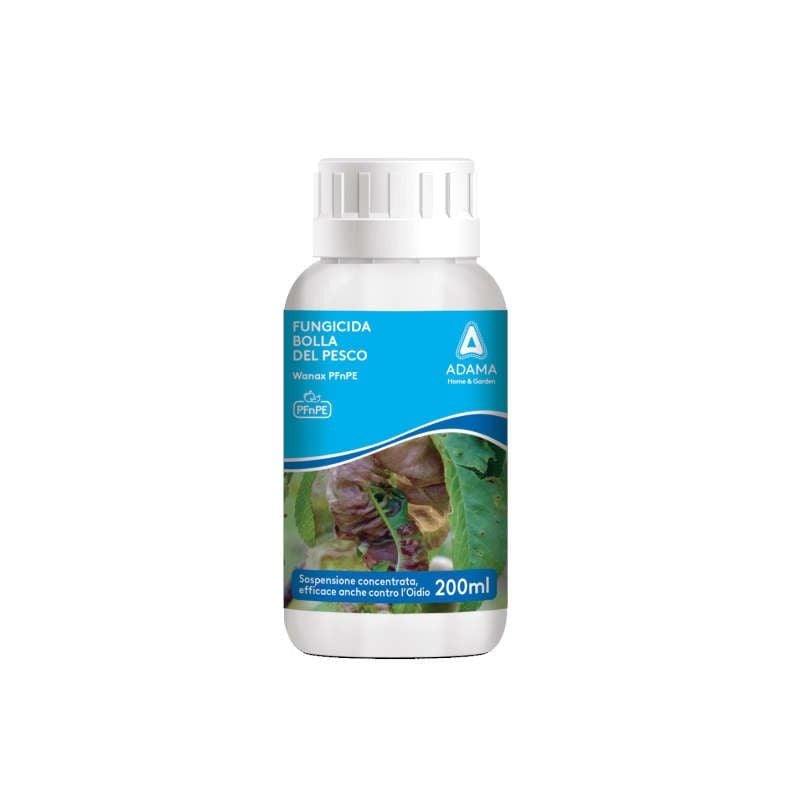
Wanax PFnPE fungicide is characterized by ready and easy dispersion in water.
Concentrated Suspension (SC)
One of the main features of Wanax PFnPE Peach Blister Fungicide is its high adhesiveness, which ensures uniform and long-lasting coverage of treated vegetation. In addition, the flowable formulation provides high resistance to runoff and prolonged persistence, offering continuous protection against fungal infections.
Sulfur, which makes up 56.09% of the composition (equivalent to 800 g/l), plays a key role in inhibiting fungal growth, thus preventing the spread of disease.
This fungicide acts by contact, which means that it acts directly on the treated surface, blocking the infection before it can penetrate the plant. It is particularly effective against Peach Blight and Powdery mildew, but is also suitable for use on a wide range of crops, including :
- grapevine, against powdery mildew (Erysiphe necator): use 30 mL of product per 10liters of water per 100sqm (corresponding to 0.3 mL of product per 100mL of water per square meter) for preventive treatments, when the disease is not present but predisposing weather conditions are present. Increase the dose up to 40 mL of product per 10liters of water when disease occurs and/or there is high disease pressure. Comply with the maximum number of treatments per year of: 8 Comply with the minimum interval between treatments of: 7 days Comply with the safety interval, or minimum time, between the last treatment and harvest of: 5 days
- cereals, against powdery mildew (Blumeria graminis) use 160 mL of product per 10 liters of water per 200 square meters (corresponding to 0.8 mL of product in 50mL of water per square meter) for preventive treatments, when the disease is not present but there are predisposing weather conditions. Increase the dose up to 200 mL of product per 10liters of water when disease occurs and/or there is high disease pressure. Comply with the maximum number of treatments per year of: 4 Comply with the minimum interval between treatments of: 10 days Comply with the safety interval, or minimum time, between the last treatment and harvest of: 5 days
- tomato and other fruit vegetables (Pepper, Eggplant, Cucurbitaceae with edible skin such as cucumber, gherkin, zucchini, and inedible such as melon, watermelon, squash) grown in the field and/or greenhouse: against Powdery mildew (Leveillula taurica, Golovinomyces sp., Podosphaera sp ., Sphaerotheca fuliginea) use 1.40 mL of product per 1L of water per approximately 7 square meters (corresponding to 0.2 mL of product in 150mL of water per square meter) for preventive treatments, when the disease is not present but there are predisposing weather conditions, and/or when the disease occurs. Comply with the maximum number of treatments per year of: 6 Comply with the minimum interval between treatments of: 10 days Comply with the safety interval, or minimum time, between the last treatment and harvest of: 3 days
- pome fruit, (apple, pear, quince, medlar): against scab (Venturia inaequalis, Venturia pyrina), Powdery mildew (Podosphaera leucotricha, Phyllactinia mali), Eriophytes (Eriophyes pyri), use 2mL of product per 1 liter of water per 7 square meters (corresponding to 0.3 mL of product in 150mL of water per square meter) for preventive treatments when the disease is not present but predisposing weather conditions are present. Increase the dose up to 2.6 mL of product per 1liter of water when disease occurs and/or there is high disease pressure. Comply with the maximum number of treatments per year of: 8 Comply with the minimum interval between treatments of: 7 days Comply with the safety interval, or minimum time, between the last treatment and harvest of: 5 days
- stone fruit trees , (peach, apricot, cherry, plum): against Powdery mildew (Podosphaera sp.), Blister (Taphrina deformans) use 2mL of product per 1 liter of water per 7 square meters (corresponding to 0.3 mL of product in 150mL of water per square meter) for preventive treatments, when the disease is not present but there are predisposing weather conditions. Increase the dose up to 2.6 mL of product per 1liter of water when disease occurs and/or there is high disease pressure. Comply with the maximum number of treatments per year of: 8 Comply with the minimum interval between treatments of: 7 days Comply with the safety interval, or minimum time, between the last treatment and harvest of: 5 days
- legumes. grown exclusively in the field: against powdery mildew (Erysiphe pisi) use 1.40 mL of product for every 1L of water per approximately 7 square meters (corresponding to 0.2 mL of product in 150mL of water per square meter) for preventive treatments, when the disease is not present but there are predisposing weather conditions, and/or when the disease occurs. Comply with the maximum number of treatments per year of: 6 Comply with the minimum interval between treatments of: 10 days Comply with the safety interval, or minimum time, between the last treatment and harvest of: 3 days
- hazel, against powdery mildew (Phillactina corylicola), Eriophytes (Phytoptus avellanae) use 2mL of product per 1 liter of water per 7 square meters (corresponding to 0.3 mL of product in 150mL of water per square meter) for preventive treatments, when disease is not present but predisposing weather conditions are present. Increase the dose up to 2.6 mL of product per 1liter of water when disease occurs and/or there is high disease pressure. Comply with the maximum number of treatments per year of: 8 Comply with the minimum interval between treatments of: 7 days Comply with the safety interval, or minimum time, between the last treatment and harvest of: 5 days
- floral, ornamental and forestry , grown exclusively in the family garden: against Powdery mildew (Sphaerotheca spp., Oidium chrysanthemi, Microsphaera spp ., Leveillula spp., Erysiphe spp., Phyllactinia sp., Podosphaera sp .) use 2 mL of product for every 1L of water per approximately 7 sq m (corresponding to 0.3 mL of product in 150mL of water per square meter) for preventive treatments, when the disease is not present but there are predisposing weather conditions, and/or when the disease occurs. Comply with the maximum number of treatments per year of: 6 Comply with the minimum time interval between treatments of: 10 days
-
-
How to use Wanax PFnPE
For optimal application, it is recommended to use the product in doses between 30 and 160 ml per 10 liters of water, depending on the level of infestation. It is essential to observe the 3-day safety interval between the last treatment and harvest to ensure the safety of the fruit and its quality.
With its unique characteristics of high adhesiveness, resistance to leaching and persistence, this product is an ideal choice for those seeking reliable and long-lasting protection against fungal diseases in crops.
Wanax PFnPE Peach Blossom Bubble Fungicide has been registered with the Ministry of Health under number 18284 dated 12/30/2022.